 MinuteRead
30 min
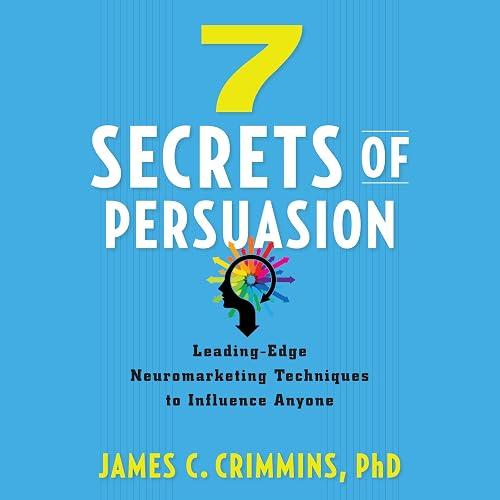
Book summary
by James C. Crimmins
Premium summary · Opens in the app · 30 min read
You have probably experienced this frustration. You present a clear, logical, well-reasoned argument. The facts are on your side. The evidence is solid. And yet, the person you are trying to persuade does not budge. Maybe they nod along, maybe they seem to agree, but their behavior never changes. They keep buying the competitor's product. They keep voting for the other candidate. They keep making the same choices you just proved were irrational.
**Author:** James C. Crimmins **Estimated Reading Time:** 45 minutes
**What You'll Learn:**
Why people really make decisions, how the nonconscious mind drives nearly every choice, and how to communicate in ways that actually influence behavior. You will learn the seven principles that separate effective persuaders from everyone else.
**Who This Book Is For:**
Anyone who needs to influence others. Marketers, salespeople, leaders, parents, negotiators, and anyone who has ever wondered why logical arguments so often fail to change minds.
You have probably experienced this frustration. You present a clear, logical, well-reasoned argument. The facts are on your side. The evidence is solid. And yet, the person you are trying to persuade does not budge. Maybe they nod along, maybe they seem to agree, but their behavior never changes. They keep buying the competitor's product. They keep voting for the other candidate. They keep making the same choices you just proved were irrational. What went wrong? The answer is uncomfortable. The problem is not your logic. The problem is your assumption about how human beings make decisions. Most of us operate with a simple model of persuasion. We believe that if we can change what people think, we can change what they do. We believe that people are rational actors who weigh evidence, evaluate options, and choose the best course of action. We believe that the path to influence runs through the conscious mind. This model is wrong. For decades, researchers in psychology, neuroscience, and behavioral economics have been building a different picture of human decision-making. The uncomfortable truth is that most of our choices are not made by the rational, conscious part of our brain. They are made by an older, faster, nonconscious system that operates below our awareness. This system shapes what we notice, what we believe, what we want, and what we do. And it does all of this without asking permission from the conscious mind. James C. Crimmins calls this system "the lizard inside." The name comes from the evolutionary history of the brain. Deep within our skulls, beneath the layers of tissue that handle language, reasoning, and planning, lies a set of structures that we share with lizards and other ancient creatures. These structures are not vestigial leftovers. They are active, powerful, and constantly at work. They process enormous amounts of information. They make decisions before we are consciously aware that a decision is being made. And in many situations, they are the sole driver of our behavior. This creates a problem for anyone who wants to persuade. If you aim your arguments at the conscious mind, you are speaking to the wrong audience. The conscious mind may hear you, but it is not the one…
Continue reading in the MinuteRead app
Get the complete 30-minute summary of 7 Secrets of Persuasion
Get the complete summary in the appMost decisions are made by the nonconscious mind, the lizard inside, not the rational conscious mind.
The lizard responds to availability and association, not logic and evidence.
Action, emotion, and social proof are the lizard's preferred forms of evidence.
Change behavior first, and attitudes will follow.
Fulfill existing desires rather than trying to create new ones.
Do not ask people what they want. Observe what they do.
"7 Secrets of Persuasion" is a strong fit if you want practical ideas around business, psychology, self help, especially themes like most decisions are made by the nonconscious mind, the lizard inside, not the rational conscious mind; the lizard responds to availability and association, not logic and evidence. The MinuteRead summary distills these concepts into a focused read, whether you're deciding whether to buy the book or applying its lessons at work.
Motivated to help readers with "Our automatic, James C. Crimmins wrote “7 Secrets of Persuasion” to package those ideas for a fast, focused read. In “7 Secrets of Persuasion”, James C. Crimmins focuses on "Our automatic. Through “7 Secrets of Persuasion”, James C. Crimmins distills the core ideas on business into lessons readers can absorb in a single short sitting. Readers turn to this work when they want James C. Crimmins's perspective on the subject without working through the entire original…
Continue Reading
Access the complete 30-minute summary and thousands more nonfiction books in the MinuteRead app.

Continue reading the complete summary in the MinuteRead app.






