 MinuteRead
30 min
Book summary
Premium summary · Opens in the app · 30 min read
Most business advice assumes a world of averages. The average customer. The average sale. The average return on marketing spend. The average employee. Entire industries run on spreadsheets built around these averages. Budgets are allocated based on them. Strategies are designed around them. Careers are built on the assumption that if you improve the average, you improve the business.
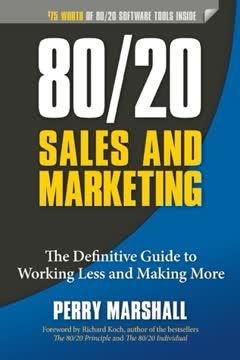
**Author:** Perry Marshall
**Estimated Reading Time:** 45 minutes
**What You'll Learn:**
- Why almost nothing in business is average, and why chasing averages destroys profits - How to find the hidden 20% of your customers, products, and activities that generate 80% of your results - The five disqualifiers that instantly separate serious buyers from time-wasters - How to use the RFM formula to rank every customer by their true value - Why delegating $10-per-hour work is the fastest path to finding $1,000-per-hour opportunities - How to apply the 80/20 principle ethically without becoming ruthless or short-sighted
**Who This Book Is For:**
Business owners who feel stretched thin. Salespeople tired of chasing unqualified leads. Marketers who suspect their campaigns are wasting money on the wrong people. Entrepreneurs who want to work less while earning more. Anyone who senses that a small fraction of their effort produces most of their results, but does not know how to systematically exploit that reality.
Most business advice assumes a world of averages. The average customer. The average sale. The average return on marketing spend. The average employee. Entire industries run on spreadsheets built around these averages. Budgets are allocated based on them. Strategies are designed around them. Careers are built on the assumption that if you improve the average, you improve the business. Perry Marshall argues that this assumption is not just wrong. It is catastrophically wrong. The world does not operate on averages. It operates on power curves. A tiny fraction of inputs produces a massive fraction of outputs. A small number of customers generate most of the profit. A handful of products dominate sales. A few activities create nearly all of your value. The rest is noise, filler, and distraction. This is the 80/20 principle, first observed by Italian economist Vilfredo Pareto in 1897 when he noticed that 80% of Italy's land was owned by 20% of the population. Since then, the pattern has shown up everywhere. In software, 80% of crashes come from 20% of bugs. In crime, 80% of offenses are committed by 20% of criminals. In business, 80% of revenue comes from 20% of customers. And here is the part most people miss: the principle is fractal. Within that top 20% of customers, the top 20% of those customers generate 80% of that revenue. Which means 4% of customers generate 64% of revenue. And within that 4%, the top 20% generate 80% of that. Which means 1% of customers generate roughly half of all revenue. Most businesses do not know who their 1% are. They treat all customers roughly the same. They spread their marketing budget evenly. They give the same level of service to a $50 customer as they…
Continue reading in the MinuteRead app
Get the complete 30-minute summary of 80/20 Sales and Marketing
Get the complete summary in the appAlmost nothing in business is average. Value follows a power curve, not a bell curve.
The top 20% of your customers generate 80% of your revenue. Find them and serve them exceptionally well.
The power curve is fractal. The top 4% generate 64% of revenue. The top 1% generate roughly half.
Use the Five Power Disqualifiers: money, need, authority, timing, and fit. Stop wasting time on unqualified prospects.
Rank your customers with RFM: Recency, Frequency, and Monetary Value.
Every task is worth $10, $100, or $1,000 per hour. Delegate $10 tasks. Focus on $1,000 tasks.
"80/20 Sales and Marketing" is a strong fit if you want practical ideas around business, finance, buisness, especially themes like almost nothing in business is average. value follows a power curve, not a bell curve; the top 20% of your customers generate 80% of your revenue. find them and serve them exceptionally well. The MinuteRead summary distills these concepts into a focused read, whether you're deciding whether to buy the book or applying its lessons at work.
Perry Marshall es un consultor de negocios altamente respetado, autor y experto en marketing. Es conocido por su trabajo en Google AdWords y por aplicar el principio 80/20 en el ámbito empresarial. Marshall fundó el Premio Evolución 2.0 y ha contribuido a diversos campos científicos y tecnológicos. Sus ideas han sido implementadas por organizaciones como la NASA. Con una formación en Ingeniería Eléctrica, Marshall integra múltiples disciplinas en su enfoque hacia los negocios y el marketing. Es …
View all summaries by Perry MarshallContinue Reading
Access the complete 30-minute summary and thousands more nonfiction books in the MinuteRead app.

Continue reading the complete summary in the MinuteRead app.






