 MinuteRead
30 min
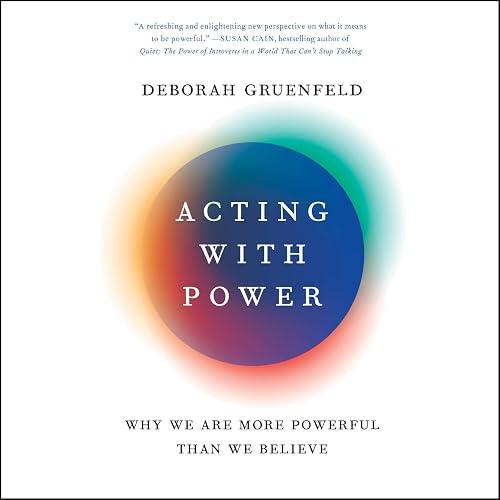
Book summary
by Deborah Gruenfeld
Premium summary · Opens in the app · 30 min read
Most of us have a complicated relationship with power. We want it. We fear it. We admire people who have it. We distrust people who seek it too openly. We tell ourselves we do not care about power while quietly resenting those who seem to have more of it than we do.
**Author:** Deborah Gruenfeld **Estimated Reading Time:** 45 minutes
### What You'll Learn
Why power is not something you have but something you do. How to step into authority without losing yourself. When to lead and when to follow. What makes people trust you with power. How to recognize and resist abuses of power. Why the most effective leaders treat power as a responsibility rather than a possession.
### Who This Book Is For
Anyone who has ever felt uncomfortable taking charge, struggled with imposter syndrome, wondered why some people command respect while others do not, or wanted to understand how power actually works in relationships, organizations, and society.
Most of us have a complicated relationship with power. We want it. We fear it. We admire people who have it. We distrust people who seek it too openly. We tell ourselves we do not care about power while quietly resenting those who seem to have more of it than we do. Deborah Gruenfeld spent decades studying this tension as a social psychologist at Stanford. What she discovered challenges nearly everything we assume about power. The most important insight is this: power is not a personal quality. It is not something you possess. It is something you do in relationship with other people. Think about how we usually talk about power. We say someone "has power" or "lacks power." We describe people as "powerful" or "powerless" as if these were fixed traits like height or eye color. We treat power as a kind of internal resource that some lucky people are born with and others must struggle to acquire. Gruenfeld argues this framing is fundamentally wrong. Power exists between people, not within them. It arises when someone needs something from someone else. It shifts as needs change. It depends on context, on relationships, on the specific moment. The same person who commands a boardroom may feel powerless in a hospital waiting room. The executive who dominates meetings may struggle to influence their teenager at home. This is actually good news. If power were a fixed trait, most of us would be stuck. But if power is a role we play, a performance we give, a relationship we manage, then we can learn to use it more effectively. We can develop the skills to step into authority when needed and step back when appropriate. We can become more versatile, more attuned to context, more capable of navigating the complex social hierarchies that shape every aspect of our lives. Gruenfeld brings an unusual perspective to this work. Before becoming an academic, she worked as a professional actress. She understands what it means to step into a role, to embody a character, to perform under…
Continue reading in the MinuteRead app
Get the complete 30-minute summary of Acting with Power
Get the complete summary in the appPower is a role you play, not a trait you possess.
You do not need to feel powerful to act with power.
Playing power up and playing power down are both essential skills.
Fear and anxiety are normal. Channel them rather than fighting them.
Sticking to the plot means fulfilling the responsibilities of your role.
Integrity matters more than authenticity. Bring your values to the role while adapting your behavior.
"Acting with Power" is a strong fit if you want practical ideas around business, psychology, leadership, especially themes like power is a role you play, not a trait you possess; you do not need to feel powerful to act with power. The MinuteRead summary distills these concepts into a focused read, whether you're deciding whether to buy the book or applying its lessons at work.
Motivated to help readers with power is not an aspect of the self; it cannot be possessed by a person, Deborah Gruenfeld wrote “Acting with Power” to package those ideas for a fast, focused read. In “Acting with Power”, Deborah Gruenfeld focuses on power is not an aspect of the self; it cannot be possessed by a person. Through “Acting with Power”, Deborah Gruenfeld distills the core ideas on business into lessons readers can absorb in a single short sitting. Readers turn to this work when they w…
Continue Reading
Access the complete 30-minute summary and thousands more nonfiction books in the MinuteRead app.

Continue reading the complete summary in the MinuteRead app.






