 MinuteRead
30 min
Book summary
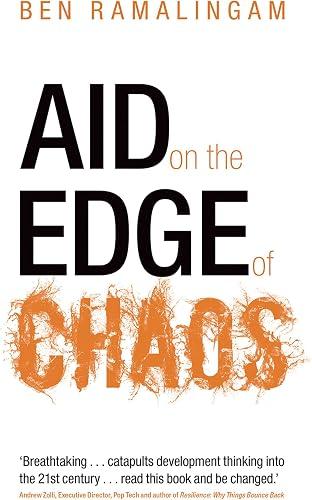
by Ben Ramalingam
Premium summary · Opens in the app · 30 min read
The world spends more than two hundred billion dollars on international aid every year. Governments, foundations, and private donors pour money into projects designed to end poverty, improve health, expand education, and build infrastructure in the world's poorest countries. The people who work in aid are, by and large, deeply committed to these goals. They work long hours in difficult conditions. They genuinely want to help.
**Author:** Ben Ramalingam **Estimated Reading Time:** 45 minutes
**What You'll Learn:**
- Why the international aid system, despite noble intentions, so often fails to deliver lasting change - How complexity science offers a powerful new lens for understanding development challenges - Why local knowledge and participation matter more than external expertise - What it means to operate at "the edge of chaos" in humanitarian work - How to shift from rigid blueprint thinking to adaptive, catalytic approaches
**Who This Book Is For:**
This book is for anyone who has ever wondered why foreign aid so often falls short of its promises. It is for development practitioners frustrated by bureaucratic constraints, for donors seeking greater impact, for students of international relations and complex systems, and for curious readers who want to understand why solving global poverty is harder than it looks. If you have ever suspected that the way we approach aid is fundamentally flawed, this book will give you the language and frameworks to understand why, and the tools to imagine something better.
The world spends more than two hundred billion dollars on international aid every year. Governments, foundations, and private donors pour money into projects designed to end poverty, improve health, expand education, and build infrastructure in the world's poorest countries. The people who work in aid are, by and large, deeply committed to these goals. They work long hours in difficult conditions. They genuinely want to help. And yet, the results are often disappointing. Projects fail. Money disappears. Wells are dug and then abandoned. Schools are built and then left empty. Agricultural programs designed to increase crop yields end up destroying local farming systems that had worked for centuries. Health campaigns eradicate one disease only to see another emerge in its place. The gap between intention and outcome is vast, and it has persisted for decades. Ben Ramalingam's book "Aid on the Edge of Chaos" confronts this uncomfortable reality head-on. It argues that the problem is not a lack of resources or a lack of goodwill. The problem is that the aid system operates with a fundamentally flawed understanding of how change happens in complex human systems. The traditional approach to aid is built on a mechanical worldview. It assumes that development is a linear process, that problems can be broken down into discrete parts, that solutions can be designed in advance and implemented according to plan. It assumes that if we just gather enough data, write good enough proposals, and follow best practices, we will achieve our goals. But development does not work that way. Development happens in complex systems: economies, societies, ecosystems, and political institutions that are interconnected, unpredictable, and constantly evolving. In these systems, cause…
Continue reading in the MinuteRead app
Get the complete 30-minute summary of Aid on the Edge of Chaos
Get the complete summary in the appThe aid system fails because it treats complex problems as if they were simple ones.
Development happens in complex systems that are interconnected, unpredictable, and constantly evolving.
The mechanical mindset fragments problems, assumes linear causality, and ignores context.
Networks matter more than hierarchies. Informal relationships shape how aid actually works.
Feedback loops create unintended consequences. Ignoring them undermines aid effectiveness.
Adaptation is essential in a changing world. Rigid plans are brittle.
"Aid on the Edge of Chaos" is a strong fit if you want practical ideas around international development, economics, politics, especially themes like the aid system fails because it treats complex problems as if they were simple ones; development happens in complex systems that are interconnected, unpredictable, and constantly evolving. The MinuteRead summary distills these concepts into a focused read, whether you're deciding whether to buy the book or applying its lessons at work.
Motivated to help readers with ultimately, Ben Ramalingam wrote “Aid on the Edge of Chaos” to package those ideas for a fast, focused read. Through “Aid on the Edge of Chaos”, Ben Ramalingam distills the core ideas on international development into lessons readers can absorb in a single short sitting. Readers turn to this work when they want Ben Ramalingam's perspective on the subject without working through the entire original volume. The book is structured so each chapter highlights a practica…
Continue Reading
Access the complete 30-minute summary and thousands more nonfiction books in the MinuteRead app.

Continue reading the complete summary in the MinuteRead app.