 MinuteRead
30 min
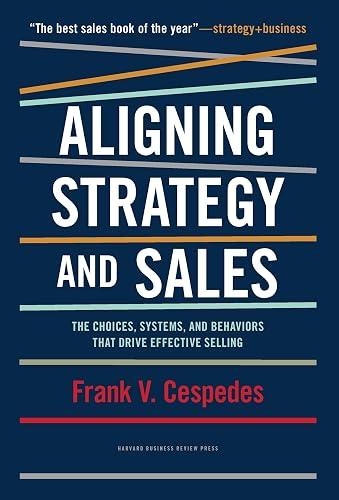
Book summary
by Frank V. Cespedes
Premium summary · Opens in the app · 30 min read
Every year, companies spend enormous sums developing strategies. They hire consultants, conduct market analyses, run leadership offsites, and produce detailed plans that promise growth, differentiation, and competitive advantage. Then they hand those plans to their sales organizations and hope for the best.
**Author:** Frank V. Cespedes
**Estimated Reading Time:** 45 minutes
**What You'll Learn:**
- Why most companies fail to connect their strategic plans with their sales execution - How to define selling tasks that actually match your business strategy - What customer selection reveals about your true competitive position - Why compensation plans so often produce the wrong behaviors - How to build sales management systems that drive real economic value
**Who This Book Is For:**
This book is for leaders who sense a gap between what their company says it wants to achieve and what actually happens in the marketplace. It is for executives frustrated by beautiful strategic plans that never seem to translate into revenue. It is for sales leaders tired of being treated as tactical executors rather than strategic partners. And it is for anyone who suspects that the distance between the boardroom and the customer conversation is where most business value is either created or destroyed.
Every year, companies spend enormous sums developing strategies. They hire consultants, conduct market analyses, run leadership offsites, and produce detailed plans that promise growth, differentiation, and competitive advantage. Then they hand those plans to their sales organizations and hope for the best. The result is often disappointing. The strategy that looked brilliant on paper fails to produce results in the marketplace. Revenue stalls. Margins erode. Competitors gain ground. Leaders wonder what went wrong. Frank Cespedes argues that what went wrong is not the strategy itself but the failure to align it with the organization's most expensive and most important implementation mechanism: the sales force. The disconnect is widespread. In most companies, strategy and sales operate in separate worlds. Strategists think about markets, competitors, and positioning. Salespeople think about accounts, quotas, and commissions. The two groups speak different languages, use different time horizons, and measure success differently. They rarely meet, and when they do, they often talk past each other. This separation is costly. US companies invest approximately $900 billion annually in sales forces. That is five times more than total media advertising and twenty times online advertising expenditure. Yet while companies obsess over optimizing their advertising spend, they rarely apply the same rigor to their sales investments. Sales remains one of the least analyzed, least understood, and least strategically managed functions in most organizations. The problem is not that salespeople lack talent or effort. The problem is that they are often asked to execute strategies that were developed without understanding what selling actually requires. They are given targets that do not reflect market realities. They are compensated in ways that reward the wrong behaviors. They are managed by people who were promoted for being good salespeople but never taught how to…
Continue reading in the MinuteRead app
Get the complete 30-minute summary of Aligning Strategy and Sales
Get the complete summary in the appStrategy is a set of choices about where to compete, how to compete, and what value to offer. Every choice involves trad
Sales is the most expensive part of implementation for most firms and must be managed as a strategic asset, not a cost c
Selling effectiveness depends on the sales task. Define the task precisely before designing hiring, training, metrics, o
Customer selection determines the economics of your business. Not all customers are equally valuable.
Performance management is a strategic tool. What gets measured and discussed gets done.
Compensation plans communicate priorities. Salespeople respond rationally to the incentives they are given.
"Aligning Strategy and Sales" is a strong fit if you want practical ideas around business, management, leadership, especially themes like strategy is a set of choices about where to compete, how to compete, and what value to offer. every choice involves trad; sales is the most expensive part of implementation for most firms and must be managed as a strategic asset, not a cost c. The MinuteRead summary distills these concepts into a focused read, whether you're deciding whether to buy the book or applying its lessons at work.
Motivated to help readers with strategy is fundamentally the movement of an organization from its present position to a desirable but, Frank V. Cespedes wrote “Aligning Strategy and Sales” to package those ideas for a fast, focused read. In “Aligning Strategy and Sales”, Frank V. Cespedes focuses on strategy is fundamentally the movement of an organization from its present position to a desirable but. Through “Aligning Strategy and Sales”, Frank V. Cespedes distills the core ideas on business in…
Continue Reading
Access the complete 30-minute summary and thousands more nonfiction books in the MinuteRead app.

Continue reading the complete summary in the MinuteRead app.






