MinuteRead
30 min
Book summary
Premium summary · Opens in the app · 30 min read
Every day, you participate in dozens of conversations. You speak with colleagues, family members, friends, and strangers. You exchange words, share information, and make decisions based on what you hear. But what if the words people say are only a small fraction of what they are actually communicating?
**Author:** Henrik Fexeus **Estimated Reading Time:** 45 minutes
**What You'll Learn:**
How to understand what people are really thinking and feeling, even when they are not saying it. You will learn to read body language, recognize hidden emotions, build instant rapport, adapt your communication to match how others think, and ethically influence the people around you.
**Who This Book Is For:**
Anyone who wants to become a better communicator. Whether you are a manager who needs to motivate a team, a salesperson who wants to understand clients, a parent trying to connect with a teenager, or simply someone who wants deeper friendships, this book gives you the tools to see beneath the surface of everyday interactions.
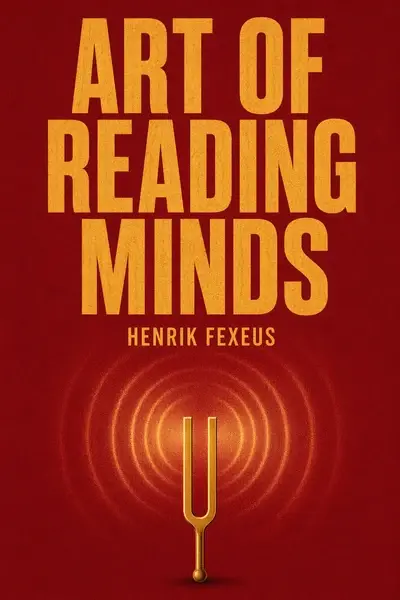
Every day, you participate in dozens of conversations. You speak with colleagues, family members, friends, and strangers. You exchange words, share information, and make decisions based on what you hear. But what if the words people say are only a small fraction of what they are actually communicating? The truth is that most human communication happens without words. Your posture, your facial expressions, the speed of your speech, the direction of your gaze, the subtle movements of your hands: all of these signals broadcast your true thoughts and feelings constantly. And you are broadcasting them whether you know it or not. Henrik Fexeus, a Swedish mentalist and expert in nonverbal communication, has spent his career studying how people reveal their inner worlds without speaking. In *The Art of Reading Minds*, he argues that the ability to read these silent signals is not a supernatural gift. It is a skill. And like any skill, it can be learned, practiced, and mastered. The problem most people face is not a lack of information. It is a lack of attention. You are surrounded by nonverbal cues every moment of every day, but you have been trained since childhood to focus on words. You listen to what people say while ignoring how they say it. You miss the micro-expressions that flash across a face in a fraction of a second. You fail to notice when someone's posture shifts from open to closed. You do not register the subtle changes in breathing that signal rising anxiety or excitement. This book exists to change that. Fexeus draws on decades of research in psychology, neuroscience, and communication studies to create a practical guide to understanding people. But unlike academic textbooks, this book is written for real life. It shows you how to use these skills in business meetings, family dinners, first dates, and casual conversations. What makes Fexeus's approach different is his background as a mentalist. Mentalists are performers who create the illusion of mind reading. But Fexeus is quick to…
Continue reading in the MinuteRead app
Get the complete 30-minute summary of Art of Reading Minds
Get the complete summary in the app**Rapport is the foundation.** If I am the same as you, you will understand and like me.
**Most communication is nonverbal.** Pay attention to bodies, not just words.
**Mirror to connect.** Subtly match posture, speech, and gestures to build rapport.
**Lead after rapport.** Once connected, you can guide others toward positive states.
**Speak their sensory language.** Match visual, auditory, or kinesthetic preferences.
**Emotions are physical.** Learn to recognize the signs of the seven universal emotions.
"Art of Reading Minds" is a strong fit if you want practical ideas around inspiration, psychology, self help, especially themes like **rapport is the foundation.** if i am the same as you, you will understand and like me; **most communication is nonverbal.** pay attention to bodies, not just words. The MinuteRead summary distills these concepts into a focused read, whether you're deciding whether to buy the book or applying its lessons at work.
Henrik Fexeus is a Swedish mentalist, author, and TV host known for his expertise in body language and non-verbal communication. He holds a BA in Philosophy from Stockholm University and has worked in communications and marketing. Henrik Fexeus has written seven books on practical psychology and influence, with his first book, "The Art of Reading Minds," released in 2007. His books have been translated into over 30 languages and sold more than a million copies worldwide. Fexeus is a frequent gue…
View all summaries by Henrik FexeusContinue Reading
Access the complete 30-minute summary and thousands more nonfiction books in the MinuteRead app.

Continue reading the complete summary in the MinuteRead app.