 MinuteRead
30 min
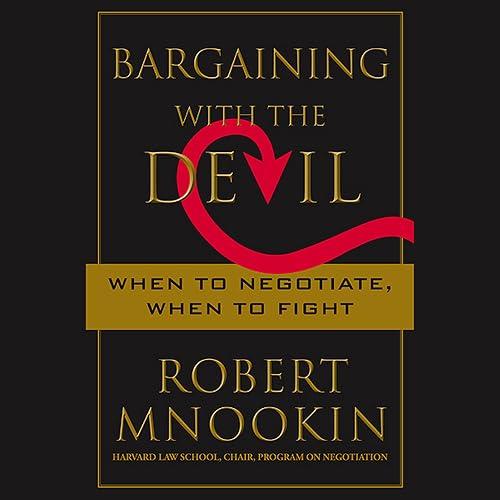
Book summary
by Robert Mnookin
Premium summary · Opens in the app · 30 min read
There is a moment in every serious conflict when you must decide what to do next. The other side has wronged you, perhaps badly. They have broken promises, inflicted harm, or taken something that was yours. Your instincts tell you to fight. Your advisors may tell you to stand firm. Your principles may tell you that sitting down with such people would be a betrayal of everything you believe.
**Author:** Robert Mnookin **Estimated Reading Time:** 45 minutes
**What You'll Learn:** How to decide whether to negotiate with an adversary you distrust, fear, or even despise. You will learn a systematic framework for making this decision, understand the psychological traps that distort judgment, and discover how some of history's most effective negotiators balanced empathy with assertiveness to achieve remarkable outcomes.
**Who This Book Is For:** Leaders facing difficult disputes, professionals navigating high-stakes conflicts, anyone locked in a bitter family or business disagreement, and readers who want to understand how principled negotiation works even when the other side seems unreasonable.
There is a moment in every serious conflict when you must decide what to do next. The other side has wronged you, perhaps badly. They have broken promises, inflicted harm, or taken something that was yours. Your instincts tell you to fight. Your advisors may tell you to stand firm. Your principles may tell you that sitting down with such people would be a betrayal of everything you believe. Robert Mnookin has spent his career studying what happens in that moment. As a professor at Harvard Law School, a mediator in complex international disputes, and an arbitrator in high-stakes commercial conflicts, he has seen the same pattern repeat itself across cultures, industries, and personal relationships. People facing a difficult adversary often make the decision to negotiate or not negotiate based on emotion rather than analysis. They treat the question as a matter of moral intuition rather than strategic calculation. And they frequently get it wrong. The central problem is that negotiation with an adversary feels like surrender. When someone has harmed you, the idea of offering them anything feels unjust. Why should you give something to the person who caused the problem in the first place? Why should you treat them as a legitimate counterpart when they have behaved illegitimately? These feelings are powerful and understandable. But they are also dangerous. Mnookin's insight is that the decision to negotiate should not be driven by how you feel about the other side. It should be driven by a careful assessment of your alternatives. The question is not whether the other side deserves to negotiate with you. The question is whether negotiating serves your interests better than the alternatives available to you. This book exists because that question is harder to answer than it appears. It requires you to think clearly under conditions of anger, fear, and moral outrage. It requires you to consider the possibility that giving something to someone who does not deserve it might be the best available option. It requires you to distinguish between what feels right and what actually works. The stakes could not be higher. Leaders make…
Continue reading in the MinuteRead app
Get the complete 30-minute summary of Bargaining with the Devil
Get the complete summary in the appThe decision to negotiate should be based on a careful analysis of costs and benefits, not on emotional reactions or mor
Use the five questions: interests, alternatives, costs, potential agreements, and implementation likelihood.
The negative traps are automatic and affect everyone. Recognize them and actively counteract them.
Justice is backward-looking; resolution is forward-looking. Focus on the future.
Empathy means understanding, not agreeing. Assertiveness means advocating, not attacking. Use both.
Nelson Mandela demonstrated that negotiation with an evil adversary is possible without abandoning principles.
"Bargaining with the Devil" is a strong fit if you want practical ideas around business, psychology, self help, especially themes like the decision to negotiate should be based on a careful analysis of costs and benefits, not on emotional reactions or mor; use the five questions: interests, alternatives, costs, potential agreements, and implementation likelihood. The MinuteRead summary distills these concepts into a focused read, whether you're deciding whether to buy the book or applying its lessons at work.
Motivated to help readers with when we feel like fighting, Robert Mnookin wrote “Bargaining with the Devil” to package those ideas for a fast, focused read. In “Bargaining with the Devil”, Robert Mnookin focuses on when we feel like fighting. Through “Bargaining with the Devil”, Robert Mnookin distills the core ideas on business into lessons readers can absorb in a single short sitting. Readers turn to this work when they want Robert Mnookin's perspective on the subject without working through t…
Continue Reading
Access the complete 30-minute summary and thousands more nonfiction books in the MinuteRead app.

Continue reading the complete summary in the MinuteRead app.






