 MinuteRead
30 min
Book summary
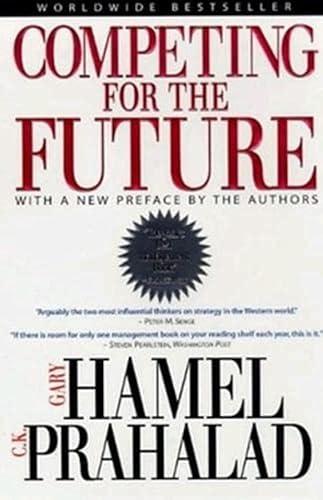
by Gary Hamel
Premium summary · Opens in the app · 30 min read
Every company has a strategy. Most companies have a budget. Many have a vision statement mounted on a wall somewhere. Yet remarkably few companies have a point of view about the future that is distinctive, well-articulated, and translated into action.
**Author:** Gary Hamel (with C.K. Prahalad)
**Estimated Reading Time:** 45 minutes
**What You'll Learn:**
- Why most companies are managed for the present but not prepared for the future - How to develop industry foresight that reveals opportunities competitors miss - The role of core competencies in unlocking new markets - How to use strategic intent and resource leverage to punch above your weight - Why expeditionary marketing beats waiting for perfect information - How to build banner brands that create customer predisposition - What it takes to transform your organization before crisis forces you to
**Who This Book Is For:**
Leaders who sense their industry is changing faster than their company. Strategists tired of incremental planning cycles. Entrepreneurs who want to shape markets rather than chase them. Anyone who suspects that the future belongs not to the largest or richest companies, but to those who see it first and act with conviction.
Every company has a strategy. Most companies have a budget. Many have a vision statement mounted on a wall somewhere. Yet remarkably few companies have a point of view about the future that is distinctive, well-articulated, and translated into action. This is the central problem Gary Hamel and C.K. Prahalad address in *Competing for the Future*. Their argument, developed over years of research with hundreds of companies across the world, is both simple and unsettling: most senior executives spend less than three percent of their time thinking about the future. They are so consumed by restructuring, reengineering, and quarterly earnings that they have outsourced the future to chance. The consequences of this neglect are visible everywhere. Industry after industry has been disrupted not by companies that had more resources, but by companies that had more foresight. Consider the American television industry in the 1970s. RCA, Zenith, and GE dominated the market. They had the technology, the distribution, the brands, and the capital. Yet within two decades, the center of gravity in consumer electronics had shifted decisively to Japan. How did Sony, Matsushita, and Sharp, companies that had been making transistor radios and basic appliances, come to dominate televisions, VCRs, and eventually the entire consumer electronics landscape? The answer, Hamel and Prahalad argue, is not that American companies were stupid or lazy. It is that they were managing for the present while their Japanese competitors were competing for the future. The American companies asked: "How can we protect our current market share?" The Japanese companies asked: "What capabilities will we need to lead this industry in twenty years, and how do we build them now?" This distinction matters enormously. When you manage for the present, you optimize existing products, squeeze costs, and defend market share. When you compete…
Continue reading in the MinuteRead app
Get the complete 30-minute summary of Competing for the Future
Get the complete summary in the app**Compete for the future, not just the present.** Allocate time and resources to developing foresight and building futur
**Develop industry foresight.** Challenge assumptions, look from the customer's perspective, study other industries, and
**Create strategic architecture.** Identify the competencies to build, the benefits to offer, and the interface changes
**Identify and nurture core competencies.** Use the three tests: market access, customer benefit, and difficulty of imit
**Set strategic intent with stretch.** Create a gap between ambition and resources that forces innovation.
**Achieve resource leverage.** Concentrate, accumulate, complement, conserve, and recover resources.
"Competing for the Future" is a strong fit if you want practical ideas around business, management, leadership, especially themes like **compete for the future, not just the present.** allocate time and resources to developing foresight and building futur; **develop industry foresight.** challenge assumptions, look from the customer's perspective, study other industries, and. The MinuteRead summary distills these concepts into a focused read, whether you're deciding whether to buy the book or applying its lessons at work.
Motivated to help readers with industry foresight is based on deep insights into the trends in technology, Gary Hamel wrote “Competing for the Future” to package those ideas for a fast, focused read. In “Competing for the Future”, Gary Hamel focuses on industry foresight is based on deep insights into the trends in technology. Through “Competing for the Future”, Gary Hamel distills the core ideas on business into lessons readers can absorb in a single short sitting. Readers turn to this work whe…
View all summaries by Gary HamelContinue Reading
Access the complete 30-minute summary and thousands more nonfiction books in the MinuteRead app.

Continue reading the complete summary in the MinuteRead app.






