MinuteRead
30 min
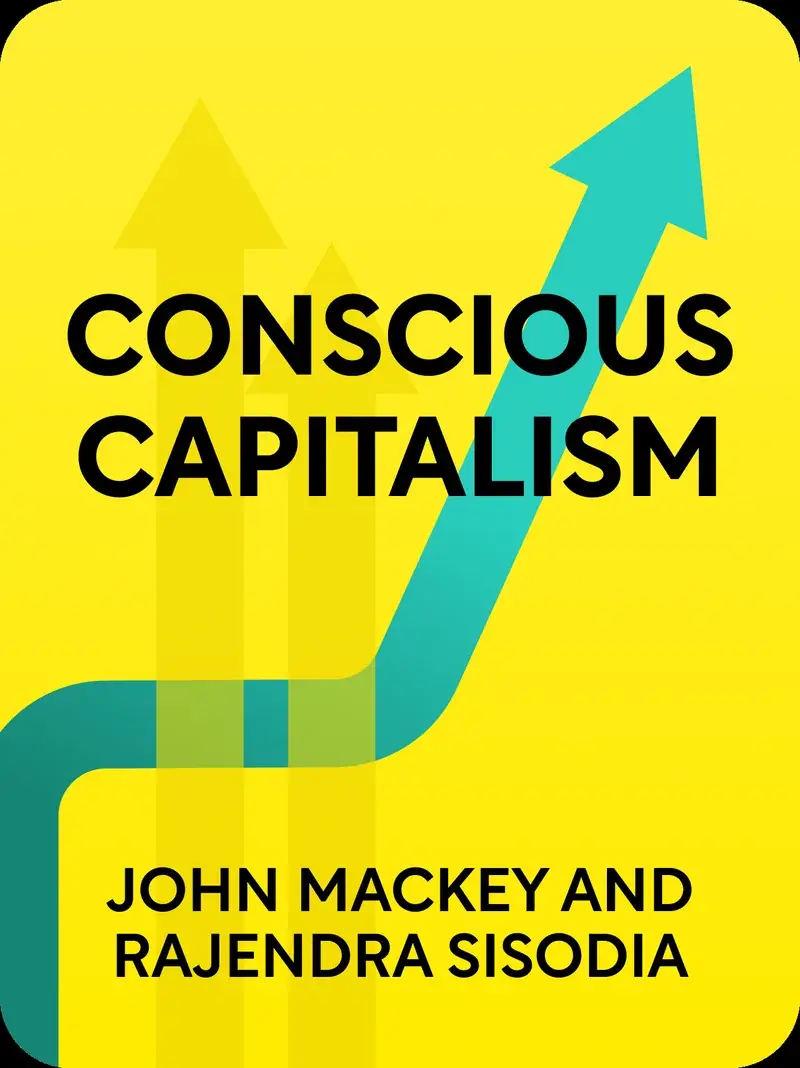
Book summary
Premium summary · Opens in the app · 30 min read
For decades, the dominant story about business has been remarkably consistent. Companies exist to maximize shareholder value. Profit is the only metric that matters. Business is a necessary evil, a zero-sum game where one party wins and another loses. This narrative has become so deeply embedded in our culture that most people accept it without question.
**Author:** John Mackey and Raj Sisodia
**Estimated Reading Time:** 45 minutes
**What You'll Learn:** Why business is fundamentally good, how purpose-driven companies outperform their competitors, and what it takes to build an organization that creates value for everyone it touches.
**Who This Book Is For:** Business leaders questioning whether profit should be the only goal, entrepreneurs building companies they want to last, employees seeking meaning in their work, and anyone who suspects capitalism can be a force for good.
For decades, the dominant story about business has been remarkably consistent. Companies exist to maximize shareholder value. Profit is the only metric that matters. Business is a necessary evil, a zero-sum game where one party wins and another loses. This narrative has become so deeply embedded in our culture that most people accept it without question. Yet something is profoundly wrong with this story. Consider the evidence. Employee engagement levels have remained stubbornly low for decades, with most workers reporting they feel disconnected from their jobs. Consumer trust in corporations continues to erode. Environmental degradation accelerates. Income inequality widens. Meanwhile, a growing number of people report feeling that their work lacks meaning and that the companies they buy from do not share their values. The conventional response to these problems has been to treat business as the enemy. Governments pass regulations. Activists organize boycotts. Employees unionize. Consumers demand change through protests and social media campaigns. All of these approaches share a common assumption: business must be constrained, controlled, and forced to behave better. John Mackey and Raj Sisodia propose something radically different. They argue that business itself, when practiced consciously, is not the problem but the solution. The issue is not capitalism as a system but the narrow, distorted version of capitalism that has dominated business thinking for the past century. What we need is not less business but better business. The authors bring unusual credibility to this argument. Mackey co-founded Whole Foods Market and led it for more than four decades, growing a single natural foods store in Austin, Texas into a global company with over 500 locations and annual sales exceeding $22 billion. Along the way, he built one of the most admired companies in America, consistently ranked among the best places to work while delivering exceptional returns to investors. Sisodia is a distinguished business professor who has spent his career studying companies that prioritize purpose over profit, documenting their performance and distilling their practices into teachable principles. Together, they make a compelling case that conscious businesses, companies that exist for a purpose beyond profit and consider the interests of all their stakeholders, outperform their conventional competitors by significant margins. This is not a feel-good theory. It is a…
Continue reading in the MinuteRead app
Get the complete 30-minute summary of Conscious Capitalism
Get the complete summary in the appBusiness is fundamentally good, creating value through voluntary exchange and lifting people out of poverty.
Profit is necessary but insufficient as a purpose. Companies need a higher purpose that inspires and guides.
The four tenets of Conscious Capitalism are higher purpose, stakeholder integration, conscious leadership, and conscious
Stakeholder interests are fundamentally aligned. Seek win-win solutions rather than accepting trade-offs.
Conscious leaders are motivated by service to the purpose and stakeholders, not personal gain.
Conscious cultures embody trust, accountability, caring, transparency, integrity, loyalty, and egalitarianism.
"Conscious Capitalism" is a strong fit if you want practical ideas around business, economics, leadership, especially themes like business is fundamentally good, creating value through voluntary exchange and lifting people out of poverty; profit is necessary but insufficient as a purpose. companies need a higher purpose that inspires and guides. The MinuteRead summary distills these concepts into a focused read, whether you're deciding whether to buy the book or applying its lessons at work.
John Mackey is an entrepreneur and co-founder of Whole Foods Market, serving as CEO for 44 years. Under his leadership, the company grew from a single store to 540 locations across multiple countries, with annual sales exceeding $22 billion. Mackey co-founded the Conscious Capitalism Movement and co-authored several books on business, leadership, and diet. He is known for his advocacy of conscious business practices and has served on the boards of various organizations. Mackey's work extends bey…
View all summaries by Rajendra SisodiaContinue Reading
Access the complete 30-minute summary and thousands more nonfiction books in the MinuteRead app.

Continue reading the complete summary in the MinuteRead app.