 MinuteRead
30 min
Book summary
Premium summary · Opens in the app · 30 min read
For decades, the relationship between business and society was understood in simple terms. Companies existed to generate profit. Governments existed to address social problems. Charities existed to fill the gaps. Each operated in its own sphere, and the boundaries between them were rarely crossed.
By Philip Kotler
Estimated Reading Time: 55 minutes
What You'll Learn:
* Why corporate social responsibility has become a strategic necessity rather than an optional extra * The six distinct types of social initiatives companies can pursue and how to choose among them * How to align social impact with business goals for maximum benefit on both sides * The practical mechanics of designing, implementing, and measuring CSR programs * How nonprofits can approach corporations to build lasting, mutually beneficial partnerships
Who This Book Is For:
Business leaders who want to move beyond ad-hoc charitable giving toward strategic social impact. Marketing professionals seeking to understand how social initiatives affect brand equity and customer loyalty. Nonprofit executives who need to secure corporate partners. Students of business and marketing who want a clear framework for understanding the evolving relationship between commerce and social good.
For decades, the relationship between business and society was understood in simple terms. Companies existed to generate profit. Governments existed to address social problems. Charities existed to fill the gaps. Each operated in its own sphere, and the boundaries between them were rarely crossed. That world no longer exists. Companies do not function in isolation from the society around them. Their ability to compete depends heavily on the circumstances of the locations where they operate. A company cannot thrive in a community that is failing. It cannot recruit talented employees in a region with poor schools. It cannot sell products to consumers who lack economic opportunity. It cannot operate efficiently in an environment degraded by pollution or instability. This recognition has fundamentally changed how businesses think about their role in the world. Corporate social responsibility, once dismissed as a peripheral concern or a public relations exercise, has moved to the center of strategic planning. The question is no longer whether companies should engage in social initiatives, but how they can do so most effectively. The shift has been driven by multiple forces converging at once. Consumers have become more sophisticated and more demanding. They expect the brands they support to reflect their values, and they are willing to switch their loyalty when those expectations are not met. Employees, particularly younger workers, increasingly seek out employers whose purpose extends beyond profit. Investors have begun to recognize that companies with strong social and environmental practices often demonstrate better risk management and long-term performance. And the scale of social challenges, from climate change to public health to economic inequality, has grown too large for governments and nonprofits to address alone. Yet for all the enthusiasm surrounding corporate social responsibility, confusion remains about what it actually entails. Many companies still approach social initiatives haphazardly, writing checks to whatever cause happens to be…
Continue reading in the MinuteRead app
Get the complete 30-minute summary of Corporate Social Responsibility
Get the complete summary in the appCorporate social responsibility is a strategic imperative, not an optional extra. Companies that ignore it risk losing c
There are six types of social initiatives: cause promotions, cause-related marketing, corporate social marketing, corpor
Strategic alignment is essential. Choose social issues that connect to your business, your capabilities, and your values
Cause-related marketing links product sales to charitable donations, creating value for the company, the cause, and the
Corporate social marketing applies commercial marketing principles to behavior change challenges, promoting health, safe
Community volunteering mobilizes employee time and skills. Skill-based volunteering creates greater impact than generic
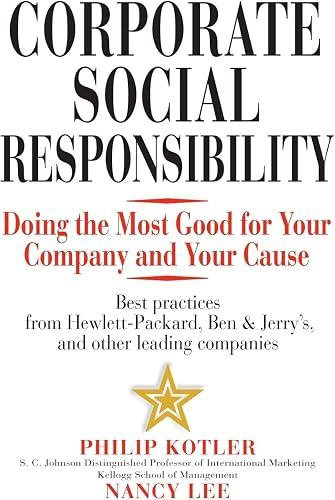
"Corporate Social Responsibility" is a strong fit if you want practical ideas around business, economics, management, especially themes like corporate social responsibility is a strategic imperative, not an optional extra. companies that ignore it risk losing c; there are six types of social initiatives: cause promotions, cause-related marketing, corporate social marketing, corpor. The MinuteRead summary distills these concepts into a focused read, whether you're deciding whether to buy the book or applying its lessons at work.
Motivated to help readers with "Companies do not function in isolation from the society around them, Philip Kotler wrote “Corporate Social Responsibility” to package those ideas for a fast, focused read. In “Corporate Social Responsibility”, Philip Kotler focuses on "Companies do not function in isolation from the society around them. Through “Corporate Social Responsibility”, Philip Kotler distills the core ideas on business into lessons readers can absorb in a single short sitting. Readers tur…
View all summaries by Philip KotlerContinue Reading
Access the complete 30-minute summary and thousands more nonfiction books in the MinuteRead app.

Continue reading the complete summary in the MinuteRead app.






