 MinuteRead
30 min
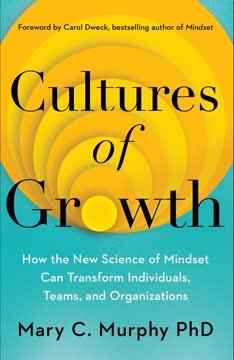
Book summary
Premium summary · Opens in the app · 30 min read
For decades, we have been told that mindset is a personal choice. Read the right book, adopt the right attitude, and you can transform how you learn, work, and live. Carol Dweck's research on fixed and growth mindsets became one of the most influential ideas in psychology, education, and business. Millions of people learned that believing abilities can be developed leads to greater resilience, better performance, and more fulfilling careers.
**Author:** Mary C. Murphy **Estimated Reading Time:** 45 minutes
How the culture around you shapes whether you think with a fixed or growth mindset, why most organizations accidentally create cultures of genius that reward talent over learning, and what leaders can do to build environments where people collaborate, innovate, and grow together.
Leaders who want to understand why their teams resist feedback or avoid risk. Employees who feel stuck in competitive, judgment-heavy workplaces. Educators and parents curious about how environments shape learning. Anyone who has read about growth mindset and wondered why it works for some people but not others.
For decades, we have been told that mindset is a personal choice. Read the right book, adopt the right attitude, and you can transform how you learn, work, and live. Carol Dweck's research on fixed and growth mindsets became one of the most influential ideas in psychology, education, and business. Millions of people learned that believing abilities can be developed leads to greater resilience, better performance, and more fulfilling careers. But there is a problem. Most people who try to adopt a growth mindset fail to sustain it. They understand the concept intellectually. They agree with it. They want to think that way. Yet when they face a difficult challenge, receive harsh feedback, or watch a colleague succeed where they struggled, they slip back into fixed thinking. They feel threatened. They hide their mistakes. They compare themselves to others and come up short. Why does this happen? Mary C. Murphy, a social psychologist at Indiana University, spent years studying this question. Her answer changes how we think about mindset entirely. Mindset is not simply a trait you possess. It is a response to the environment you inhabit. The culture around you, the unspoken rules about who is smart and who is not, the way leaders react to failure, the systems that determine who gets promoted and who gets overlooked, all of these factors shape your mindset more powerfully than any individual effort. Murphy's research reveals that most organizations, often without realizing it, operate as Cultures of Genius. In these environments, intelligence and talent are treated as fixed qualities. People are constantly evaluated, ranked, and compared. The goal is to look smart, not to learn. Mistakes are hidden. Feedback feels like a threat. Collaboration suffers because colleagues view each other as competitors. The alternative is a Culture of Growth. In these environments, ability is understood as something that develops through effort, strategy, and support. People are encouraged to take risks, share ideas, and learn from failure. Feedback is seen as a gift. Colleagues inspire rather than threaten each other. Innovation flourishes because people feel safe enough to try new things. This…
Continue reading in the MinuteRead app
Get the complete 30-minute summary of Cultures of Growth
Get the complete summary in the appMindset is a continuum, not a fixed trait. You move along it constantly based on your environment.
Cultures of Genius treat ability as fixed and reward the appearance of talent. Cultures of Growth treat ability as devel
The culture around you shapes your mindset more powerfully than any individual effort.
Psychological safety is the foundation of innovation. People will not take risks if they fear punishment for failure.
Collaboration beats competition for complex problems. Cultures of Growth define success collectively.
Feedback is a gift in Cultures of Growth and a threat in Cultures of Genius. Give specific, developmental feedback regul
"Cultures of Growth" is a strong fit if you want practical ideas around business, leadership, psychology, especially themes like mindset is a continuum, not a fixed trait. you move along it constantly based on your environment; cultures of genius treat ability as fixed and reward the appearance of talent. cultures of growth treat ability as devel. The MinuteRead summary distills these concepts into a focused read, whether you're deciding whether to buy the book or applying its lessons at work.
Mary C. Murphy is a social psychologist and endowed professor at Indiana University. Her work builds upon Carol Dweck's research on fixed and growth mindsets, focusing on how these mindsets manifest within organizational cultures. Murphy's research demonstrates that mindsets are fluid and can change based on environmental factors. She emphasizes the importance of creating "Cultures of Growth" rather than "Cultures of Genius" in various settings, including businesses and educational institutions.…
View all summaries by Mary C. MurphyContinue Reading
Access the complete 30-minute summary and thousands more nonfiction books in the MinuteRead app.

Continue reading the complete summary in the MinuteRead app.






