MinuteRead
30 min
Book summary
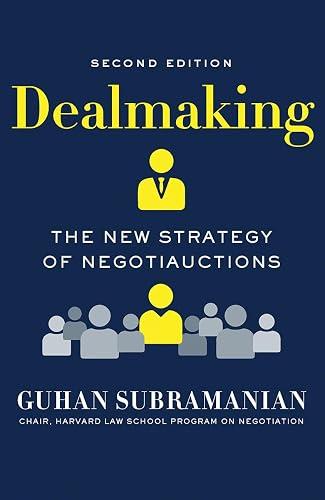
by Guhan Subramanian
Premium summary · Opens in the app · 30 min read
In the spring of 2000, the British government auctioned off licenses for third-generation mobile phone spectrum. The auction raised an astonishing £22.5 billion, far exceeding expectations. Economists celebrated. The design had worked perfectly, extracting maximum value through competitive bidding.
**Author:** Guhan Subramanian
**Estimated Reading Time:** 45 minutes
**What You'll Learn:**
- Why most important deals are neither pure negotiations nor pure auctions, but a hybrid called negotiauctions - How to set up, rearrange, and shut down deal processes to your advantage - How to avoid the winner's curse and bid with discipline - How to navigate the legal boundaries of competitive dealmaking - How to apply these strategies in real estate, corporate acquisitions, contract negotiations, and everyday life
**Who This Book Is For:**
This book is for anyone who buys, sells, or negotiates anything of value. Whether you are an executive managing a corporate acquisition, an entrepreneur selling your company, a professional negotiating a contract, or an individual buying a house, you are likely operating in a negotiauction without realizing it. This book gives you the tools to recognize the game you are actually playing and win it.
In the spring of 2000, the British government auctioned off licenses for third-generation mobile phone spectrum. The auction raised an astonishing £22.5 billion, far exceeding expectations. Economists celebrated. The design had worked perfectly, extracting maximum value through competitive bidding. Three years later, the same government faced a different challenge. It needed to sell a portfolio of broadband wireless licenses. This time, the straightforward auction approach failed spectacularly. The government received only a fraction of the expected value. What went wrong? The answer reveals a fundamental truth about modern dealmaking. The first auction worked because the assets were clearly defined, the bidders were numerous, and the value was relatively easy to estimate. The second auction failed because the assets were less certain, the bidders were fewer, and the value depended heavily on what the buyer planned to do with the licenses. In other words, the second situation required negotiation, not just competitive bidding. Most deals fall somewhere between these two extremes. They are neither pure auctions nor pure negotiations. They are hybrids. Guhan Subramanian calls them negotiauctions. The problem is that most people are trained for one or the other. Business schools teach negotiation as a separate discipline from auction theory. Lawyers learn to negotiate contracts. Investment bankers learn to run auctions. But in the real world, these lines blur constantly. Consider what happens when you buy a house. You make an offer. The seller's agent tells you there are other interested buyers. Is that true? You do not know. You are negotiating with the seller across the table, but you are also competing with other buyers on your side of the table. The seller is running an auction, but also negotiating with you directly. This is a negotiauction. Consider what happens when a company is sold. The seller's banker contacts multiple…
Continue reading in the MinuteRead app
Get the complete 30-minute summary of Dealmaking
Get the complete summary in the appMost important deals are negotiauctions, combining auction and negotiation dynamics.
Use the BASC framework to understand the deal landscape.
Process setters should design processes that balance auction and negotiation elements.
Process takers should use setup moves, rearranging moves, and shut-down moves to reshape the game.
Setup moves must be better than the process setter's perceived BATNA.
Rearranging moves reconfigure assets or parties to create value.
"Dealmaking" is a strong fit if you want practical ideas around business, economics, management, especially themes like most important deals are negotiauctions, combining auction and negotiation dynamics; use the basc framework to understand the deal landscape. The MinuteRead summary distills these concepts into a focused read, whether you're deciding whether to buy the book or applying its lessons at work.
Motivated to help readers with negotiauction is the commonplace situation in which negotiators are fighting on two fronts—across the table, Guhan Subramanian wrote “Dealmaking” to package those ideas for a fast, focused read. In “Dealmaking”, Guhan Subramanian focuses on negotiauction is the commonplace situation in which negotiators are fighting on two fronts—across the table. Through “Dealmaking”, Guhan Subramanian distills the core ideas on business into lessons readers can absorb in a single…
Continue Reading
Access the complete 30-minute summary and thousands more nonfiction books in the MinuteRead app.

Continue reading the complete summary in the MinuteRead app.