 MinuteRead
30 min
This statement encompasses both goals and duties, and it succinctly communicates what a business is all about and who it’s intended to benefit.
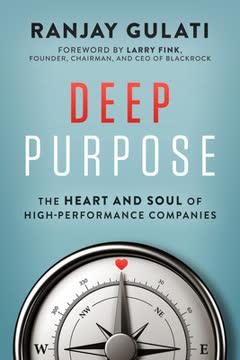
**Author:** Ranjay Gulati **Estimated Reading Time:** 42 minutes
Why some companies pursue purpose with genuine conviction while others merely decorate their annual reports with lofty statements. How deeply purposeful organizations navigate impossible tradeoffs without losing their way. What separates purpose that transforms performance from purpose that quietly fades into irrelevance. The practical mechanics of building an organization where commercial success and meaningful contribution reinforce each other.
Leaders who suspect their company's purpose statement is doing little more than gathering dust. Entrepreneurs building organizations they want to outlast them. Managers struggling to reconcile quarterly targets with long-term aspirations. Anyone who has felt the gap between what their organization claims to stand for and what it actually does.
Every company has a purpose statement. Most of them are meaningless. Walk through any corporate headquarters and you will find the words mounted on walls, printed in annual reports, and recited at town halls. "We exist to create value for all stakeholders." "Our mission is to make the world a better place through innovation." "We are committed to excellence, integrity, and community." These statements are not lies. They are simply inert. They describe aspirations that have no real purchase on how decisions get made, how resources get allocated, or how people experience their work. They are what Ranjay Gulati calls convenient purpose: language that sounds good but changes nothing. The problem is not that leaders are cynical. Most genuinely want their companies to matter. The problem is that they have been taught to think about purpose in ways that guarantee it will remain superficial. They treat purpose as a tool for boosting engagement scores or polishing brand image. They search for win-win solutions that avoid difficult tradeoffs. They delegate purpose to a corporate social responsibility department and then wonder why the rest of the organization remains unmoved. Gulati spent years studying companies that have managed to do something different. He interviewed leaders who have built organizations where purpose is not a slogan but an operating system. These are companies like LEGO, which rediscovered its founding commitment to "good play" and used it to orchestrate one of the most remarkable turnarounds in business history. Companies like Etsy, which made painful decisions that seemed to betray its values in the short term but ultimately strengthened its ability to serve its community. Companies like Bühler, the Swiss manufacturer that committed to solving global food security challenges and found that this ambition unlocked innovation, loyalty, and growth. What distinguishes these organizations is not the eloquence of their purpose statements. It is the depth of their commitment. They practice what Gulati calls deep purpose: a way of being that treats the organization's reason for existence as something sacred, something…
Continue reading in the MinuteRead app
Get the complete 30-minute summary of Deep Purpose
Get the complete summary in the appDeep purpose is the reason your organization exists. It is not a tool for achieving other goals.
Convenient purpose is ornament. Deep purpose is architecture. The difference is whether purpose shapes actual decisions.
Look backward to find your purpose. It is rooted in your organization's history, not invented in a strategy offsite.
Tradeoffs are inevitable. Practical idealism means navigating them with integrity rather than pretending they do not exi
Purpose drives performance through four levers: directional, relational, reputational, and motivational. They work toget
Communicate purpose through storytelling. The Big Story critiques the status quo, evokes a better future, and issues a r
"Deep Purpose" is a strong fit if you want practical ideas around business, leadership, sustainability, especially themes like deep purpose is the reason your organization exists. it is not a tool for achieving other goals; convenient purpose is ornament. deep purpose is architecture. the difference is whether purpose shapes actual decisions. The MinuteRead summary distills these concepts into a focused read, whether you're deciding whether to buy the book or applying its lessons at work.
Ranjay Gulati is a distinguished professor at Harvard Business School, specializing in leadership, strategy, and organizational behavior. He is known for his expertise in how firms can leverage connectivity to enhance performance. Gulati's research focuses on purpose-driven organizations and their impact on business success. He has authored multiple books and conducted extensive field research, interviewing leaders of various companies. Gulati's work challenges traditional notions of corporate p…
View all summaries by Ranjay GulatiContinue Reading
Access the complete 30-minute summary and thousands more nonfiction books in the MinuteRead app.

Continue reading the complete summary in the MinuteRead app.






