 MinuteRead
30 min
Book summary
by Brent Dykes
Premium summary · Opens in the app · 30 min read
Every day, organizations collect staggering amounts of data. They track sales, monitor operations, measure customer behavior, and analyze market trends. The volume of information available to decision-makers has never been greater. Yet most of this data never fulfills its purpose. It sits in dashboards that nobody opens. It appears in reports that nobody reads. It gets presented in meetings where eyes glaze over and minds drift elsewhere.
**Author:** Brent Dykes
**Estimated Reading Time:** 42 minutes
**What You'll Learn:**
- Why data alone rarely changes minds - How to combine data, narrative, and visuals into a persuasive story - The four-part structure of every effective data story - How to select the right data and the right charts - How to remove noise and focus attention - How to adapt your story for different audiences
**Who This Book Is For:**
Analysts who want their insights to drive action. Managers who need to communicate performance. Executives who must persuade stakeholders. Anyone who has ever presented data and watched it fail to change a single mind.
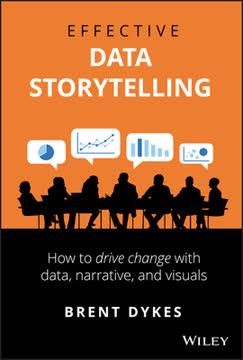
Every day, organizations collect staggering amounts of data. They track sales, monitor operations, measure customer behavior, and analyze market trends. The volume of information available to decision-makers has never been greater. Yet most of this data never fulfills its purpose. It sits in dashboards that nobody opens. It appears in reports that nobody reads. It gets presented in meetings where eyes glaze over and minds drift elsewhere. The problem is not the data. The problem is how we communicate it. Most analysts operate under a simple assumption: if I present the facts clearly, people will understand them and act accordingly. This assumption is wrong. Facts alone rarely persuade. Numbers without context feel abstract. Charts without narrative fail to engage. Insights without emotional resonance get forgotten within hours. Brent Dykes wrote Effective Data Storytelling to address this fundamental disconnect. His central argument is straightforward: data has the power to transform organizations, but only when it is communicated through story. The combination of data, narrative, and visuals creates something greater than the sum of its parts. It creates understanding that leads to action. The stakes are high. Organizations waste millions of dollars on analytics initiatives that never influence decisions. Talented analysts grow frustrated when their work is ignored. Leaders make choices based on intuition rather than evidence because the evidence was never presented in a way they could absorb. This book exists to solve that problem. Dykes brings a unique perspective to this challenge. He spent years working in analytics and digital marketing, watching brilliant analysis fail to gain traction. He observed that the analysts who succeeded were not necessarily the ones with the best technical skills. They were the ones who could tell a compelling story with their data. They understood that communication is not a soft skill. It is the skill that determines whether analysis creates value or collects dust. The approach in this book is different from typical data visualization guides. Most books focus on chart selection or design principles. Dykes goes deeper. He explores the psychology of why stories work, the structure…
Continue reading in the MinuteRead app
Get the complete 30-minute summary of Effective Data Storytelling
Get the complete summary in the appData storytelling combines data, narrative, and visuals to drive change.
Data provides credibility, narrative provides meaning, visuals provide clarity.
Engage both the logical and emotional centers of the brain.
Structure your story using the Data Storytelling Arc: setting, hook, rising insights, aha moment, solution.
Select only the data that supports your central insight.
Match chart types to insight types.
"Effective Data Storytelling" is a strong fit if you want practical ideas around business, science, especially themes like data storytelling combines data, narrative, and visuals to drive change; data provides credibility, narrative provides meaning, visuals provide clarity. The MinuteRead summary distills these concepts into a focused read, whether you're deciding whether to buy the book or applying its lessons at work.
Brent Dykes is an accomplished author and expert in data storytelling. His book demonstrates his extensive knowledge and experience in the field of data analysis and communication. Dykes' writing style is praised for being engaging and accessible, effectively conveying complex concepts to readers of various backgrounds. His approach combines theoretical foundations with practical applications, providing readers with actionable insights. Dykes' work emphasizes the importance of storytelling in da…
View all summaries by Brent DykesContinue Reading
Access the complete 30-minute summary and thousands more nonfiction books in the MinuteRead app.

Continue reading the complete summary in the MinuteRead app.






