MinuteRead
30 min
Book summary
Premium summary · Opens in the app · 5 min read
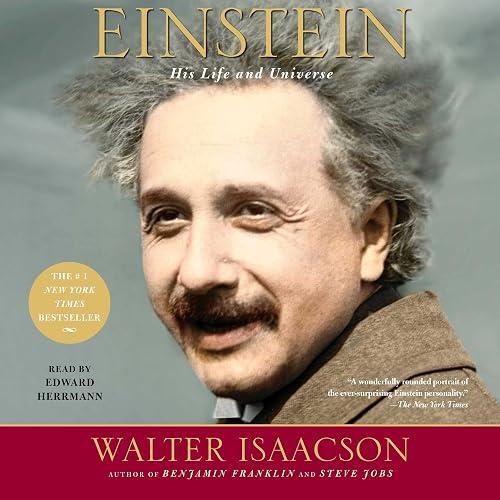
Einstein: His Life and Universe takes a close look at the life of Albert Einstein, beginning in how his childhood shaped him, what his biggest discoveries and personal struggles were and how his focus changed in later years, without his genius ever fading until his very last moment.
Einstein: His Life and Universe takes a close look at the life of Albert Einstein, beginning in how his childhood shaped him, what his biggest discoveries and personal struggles were and how his focus changed in later years, without his genius ever fading until his very last moment.
Albert Einstein had an unusual childhood. A few crucial events he would remember for the rest of his life, which ended up ensuring his never-ending sense of curiosity.
When he was sick in bed at just four years old, his Dad gave him a compass, which Albert held in amazement. He felt very excited, a rush of wonder and wanting to know more about science. This memory and feeling he kept with him.
The violin lessons his Mom arranged for him were another key component, as the music was a way for his subconscious to creatively process whatever he was thinking about – he would later often play the violin while mulling over complex physics problems.
Einstein learned about scientific concepts and important people very early as well, for example when medical student Max Talmey mentored him through his weekly visits and gave him books from Immanuel Kant and Aaron Bernstein.
Because he was Jewish, he faced social exclusion in school, and was known as a prankster, both of which in turn made him willing to venture off on his own path (which was important later, when developing his theories) and not particularly fond of authority.
One of his famous quotes is the one on top of this summary:
Einstein kept his childhood sense of wonder, which is what allowed him to do the latter and never stop questioning. Seems like his life turned out well, so you’d probably do good in keeping yours as well!
Do you know Einstein’s most famous equation? You have seen it, I’m 100% sure! It’s e=mc² and it’s part of his theory of special relativity. Part of this theory is that the speed of light is constant, which makes it the only thing that’s not relative, and therefore, time itself must be relative (A Brief History Of Time explains it well here). But Albert Einstein’s Nobel prize has nothing to do with his theory of relativity. He received it for explaining something called the photoelectric effect. He was building on the findings of Max Planck and Phillip Lenard, and his theory came down to this: The level of energy of electrons, which were ejected when, for example, light shines on a metal plate, couldn’t be explained by the intensity of the light, only by its frequency. So a stronger light just meant more emitted electrons, not higher-energy ones. Yet, based on their previous conclusions that light…
Continue reading in the MinuteRead app
Get the complete 5-minute summary of Einstein: His Life and Universe
Get the complete summary in the appNever lose your sense of childhood curiosity.
Einstein got his Nobel prize for something called the photoelectric effect.
Until the day you die, your journey through life doesn’t stop, so neither should you.
"Einstein: His Life and Universe" is a strong fit if you want practical ideas around biography, creativity, history, especially themes like never lose your sense of childhood curiosity; einstein got his nobel prize for something called the photoelectric effect. The MinuteRead summary distills these concepts into a focused read, whether you're deciding whether to buy the book or applying its lessons at work.
Walter Isaacson newest book is The Greatest Sentence Ever Written He is also the author of Elon Musk; The Code Breaker: Jennifer Doudna, Gene Editing, and the Future of the Human Race; Leonardo da Vinci; Steve Jobs; Einstein: His Life and Universe; Benjamin Franklin: An American Life; The Innovators: How a Group of Hackers, Geniuses, and Geeks Created the Digital Revolution; and Kissinger: A Biography. He is also the coauthor of The Wise Men: Six Friends and the World They Made. He is a Professo…
View all summaries by Walter IsaacsonContinue Reading
Access the complete 5-minute summary and thousands more nonfiction books in the MinuteRead app.

Continue reading the complete summary in the MinuteRead app.