 MinuteRead
30 min
Book summary
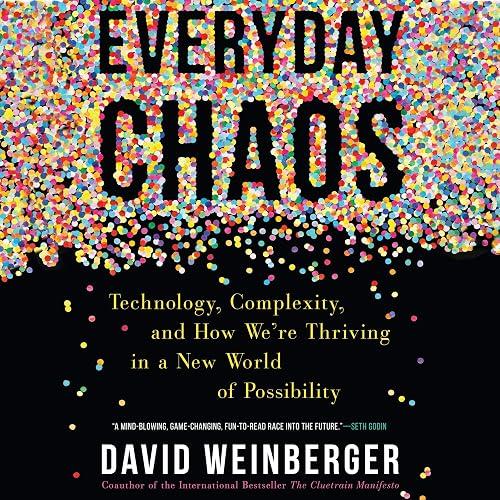
by David Weinberger
Premium summary · Opens in the app · 30 min read
For centuries, we have operated on a simple assumption: the world is orderly, and our job is to figure out the rules. We believed that beneath the apparent chaos of everyday life lay discoverable laws. If we could just find them, we could predict outcomes, control processes, and build systems that worked reliably. This assumption has driven science, shaped business strategy, and informed how we think about everything from weather to economics to human behavior.
**Author:** David Weinberger
**Estimated Reading Time:** 45 minutes
**What You'll Learn:**
- Why our oldest strategy for understanding the world, simplification, is failing us - How machine learning reveals patterns too complex for human comprehension - Why the internet's greatest innovations came from giving up control - What interoperability means and why it's replacing simple causality - How our understanding of progress, meaning, and morality is shifting - Practical ways to embrace unpredictability in your work and life
**Who This Book Is For:**
Anyone who senses that the old rules no longer apply. Leaders who feel pressure to predict what cannot be predicted. Creators who want to build things that thrive in complexity rather than fight against it. Curious minds who want to understand why our most advanced technologies are also our most mysterious. If you've ever felt that the world is becoming too complicated to manage, this book will show you why that's not a problem to solve but a reality to embrace.
For centuries, we have operated on a simple assumption: the world is orderly, and our job is to figure out the rules. We believed that beneath the apparent chaos of everyday life lay discoverable laws. If we could just find them, we could predict outcomes, control processes, and build systems that worked reliably. This assumption has driven science, shaped business strategy, and informed how we think about everything from weather to economics to human behavior. The strategy worked remarkably well. We discovered laws of physics that let us build bridges and send rockets to the moon. We developed management principles that let us coordinate thousands of workers. We created economic models that helped us understand markets. Everywhere we looked, we found patterns, and those patterns gave us power. But something has changed. Our newest tools are showing us a different picture of reality. The internet and machine learning are revealing that the world is far more complex than our old models suggested. Not just complicated in the sense of having many parts, but complex in a deeper sense: interconnected, interdependent, and fundamentally resistant to simplification. Everything affects everything else, all at once, in ways we can barely begin to trace. This revelation is uncomfortable. We have built our institutions, our strategies, and our habits of thought around the idea that we can understand and control our environment. We like clear causes and predictable effects. We want explanations we can grasp. We want plans we can rely on. The problem is that the world doesn't cooperate with these desires. The more we learn, the more we discover that simple cause-and-effect relationships are rare. Instead, we find webs of influence so dense and tangled that tracing any single…
Continue reading in the MinuteRead app
Get the complete 30-minute summary of Everyday Chaos
Get the complete summary in the appThe world is far more complex than our traditional models suggest. Everything affects everything else, all at once.
Machine learning creates models that can be accurate without being understandable. We can benefit from knowledge we don'
The internet's greatest innovations came from giving up control and enabling unanticipated uses.
Interoperability is replacing simple causality. The most valuable things we do are often the connections we enable.
Progress is not a straight line but an explosion of branching possibilities.
Meaning emerges from relationships, not from the essential qualities of things.
"Everyday Chaos" is a strong fit if you want practical ideas around business, technology, philosophy, especially themes like the world is far more complex than our traditional models suggest. everything affects everything else, all at once; machine learning creates models that can be accurate without being understandable. we can benefit from knowledge we don'. The MinuteRead summary distills these concepts into a focused read, whether you're deciding whether to buy the book or applying its lessons at work.
Motivated to help readers with we are at the beginning of a great leap forward in our powers of understanding and managing the future:, David Weinberger wrote “Everyday Chaos” to package those ideas for a fast, focused read. In “Everyday Chaos”, David Weinberger focuses on we are at the beginning of a great leap forward in our powers of understanding and managing the future:. Through “Everyday Chaos”, David Weinberger distills the core ideas on business into lessons readers can absorb in a singl…
Continue Reading
Access the complete 30-minute summary and thousands more nonfiction books in the MinuteRead app.

Continue reading the complete summary in the MinuteRead app.






