 MinuteRead
30 min
Book summary
by Salim Ismail
Premium summary · Opens in the app · 30 min read
In 2012, a startup called Instagram sold to Facebook for $1 billion. The company had thirteen employees. At the time, Kodak, the iconic photography giant, was filing for bankruptcy. Kodak had once employed 145,000 people and held a near-monopoly on capturing memories for over a century. The contrast was stark and unsettling. How could a thirteen-person company create more value in eighteen months than a century-old industrial titan could preserve in its final decade?
**Author:** Salim Ismail
**Estimated Reading Time:** 45 minutes
**What You'll Learn:** - Why some companies grow 10x faster than their competitors - The eleven attributes that define Exponential Organizations - How to transform a traditional company into an ExO - The mindset shifts required for exponential thinking - A practical framework for building your own ExO
**Who This Book Is For:** Entrepreneurs, executives, investors, and anyone who wants to understand why the rules of business have fundamentally changed and how to thrive in the new landscape.
In 2012, a startup called Instagram sold to Facebook for $1 billion. The company had thirteen employees. At the time, Kodak, the iconic photography giant, was filing for bankruptcy. Kodak had once employed 145,000 people and held a near-monopoly on capturing memories for over a century. The contrast was stark and unsettling. How could a thirteen-person company create more value in eighteen months than a century-old industrial titan could preserve in its final decade? This is not an isolated anomaly. Uber, the world's largest transportation company, owns no vehicles. Airbnb, the world's largest accommodation provider, owns no real estate. Alibaba, one of the world's largest retailers, holds no inventory. These companies have rewritten the rules of what is possible in business, and they have done so with astonishing speed. The forces behind this transformation are not mysterious. They are the result of a fundamental shift in how information and technology scale. For most of human history, growth was linear. If you wanted to sell more products, you built more factories, hired more workers, and opened more stores. Each unit of growth required a proportional unit of resources. This was the logic of the industrial age, and it worked remarkably well for two hundred years. But something changed in the late twentieth century. The cost of computing began to fall exponentially. Moore's Law, which predicted that computing power would double every eighteen to twenty-four months while costs remained constant, became the engine of a new economic reality. Information-based products and services could scale without the constraints of physical assets. Software could be duplicated infinitely at near-zero marginal cost. Platforms could connect billions of people without owning the infrastructure that made those connections possible. This shift created a new breed of organization. These companies are not merely more efficient versions of their predecessors. They operate on fundamentally different principles. They leverage external resources instead of owning them. They use data and algorithms to make decisions that once required layers of management. They pursue audacious purposes that attract communities of passionate contributors. And they grow at rates that would have seemed impossible just a generation ago. Salim Ismail calls these companies Exponential Organizations, or ExOs. An ExO…
Continue reading in the MinuteRead app
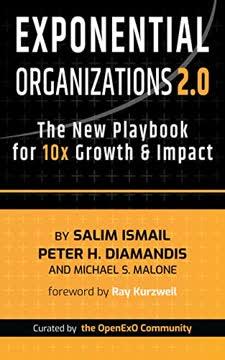
Get the complete 30-minute summary of Exponential Organizations 2.0
Get the complete summary in the appAn ExO achieves 10x the impact of its peers by leveraging accelerating technologies and new organizational techniques.
The Massive Transformative Purpose is the foundation of every ExO. It attracts talent, guides decisions, and builds comm
Information scales at near-zero marginal cost. Digitize what you can.
Leverage external resources through Staff on Demand, Community, and Leveraged Assets. You do not need to own everything.
Use Algorithms to scale decision-making without scaling management.
Build Interfaces and Dashboards to manage abundance and maintain control.
"Exponential Organizations 2.0" is a strong fit if you want practical ideas around business, leadership, science, especially themes like an exo achieves 10x the impact of its peers by leveraging accelerating technologies and new organizational techniques; the massive transformative purpose is the foundation of every exo. it attracts talent, guides decisions, and builds comm. The MinuteRead summary distills these concepts into a focused read, whether you're deciding whether to buy the book or applying its lessons at work.
Salim Ismail, Peter H. Diamandis, and Michael S. Malone are renowned experts in exponential technologies and organizational innovation. Ismail is the founding Executive Director of Singularity University, while Diamandis is the founder of XPRIZE Foundation and co-founder of Singularity University. Malone is an award-winning journalist and author specializing in technology and business. Together, they bring decades of experience in futurism, entrepreneurship, and technological innovation to provi…
View all summaries by Salim IsmailContinue Reading
Access the complete 30-minute summary and thousands more nonfiction books in the MinuteRead app.

Continue reading the complete summary in the MinuteRead app.






