MinuteRead
30 min
Every day, billions of people play games. They solve puzzles, defeat enemies, build civilizations, and chase high scores. They do this voluntarily, passionately, and for hours on end. They fail repeatedly and keep trying. They collaborate with strangers. They invest enormous mental energy in systems that offer no material reward beyond the experience itself.
**Author:** Kevin Werbach
**Estimated Reading Time:** 45 minutes
**What You'll Learn:**
- Why game elements are reshaping how companies engage customers and employees - The psychology that makes gamification work, and the mistakes that make it fail - A complete design framework for building gamified systems that last - How to move beyond points and badges into meaningful, motivating experiences - The ethical and legal boundaries every thoughtful practitioner must understand
**Who This Book Is For:**
This book is for business leaders, product managers, marketers, HR professionals, educators, and anyone who wants to understand why games captivate millions of people and how that same energy can be directed toward real-world goals. You do not need to be a gamer. You do not need to love technology. You need to care about motivation, engagement, and the design of experiences that move people to act.
Every day, billions of people play games. They solve puzzles, defeat enemies, build civilizations, and chase high scores. They do this voluntarily, passionately, and for hours on end. They fail repeatedly and keep trying. They collaborate with strangers. They invest enormous mental energy in systems that offer no material reward beyond the experience itself. Now consider the contrast. In workplaces around the world, managers struggle to get employees to complete training modules. Marketers fight for seconds of consumer attention. Teachers assign homework that students avoid. Health professionals beg patients to take their medication. The same humans who will spend an entire weekend mastering a difficult video game will avoid a fifteen-minute compliance course at all costs. What if the energy of games could be redirected toward these real-world challenges? That is the question at the heart of this book. The answer is gamification: the use of game elements and game design techniques in non-game contexts. It is not about turning everything into a game. It is not about slapping points and badges onto a website and expecting magic. It is about understanding what makes games so compelling and applying those insights to business, education, health, and society. The idea arrived with considerable hype. Around 2010, gamification became a buzzword. Conferences sprang up. Consultants promised engagement on demand. Companies rushed to add leaderboards to their intranets and badges to their loyalty programs. Many of those early efforts failed. They failed because they treated gamification as a superficial layer rather than a design philosophy. They added game mechanics without understanding game thinking. Kevin Werbach wrote this book to separate the signal from the noise. As a professor at the Wharton School, he saw both the potential and the pitfalls. He recognized that gamification, done well, could transform how organizations motivate people. Done poorly, it could breed cynicism and disengagement.…
Continue reading in the MinuteRead app
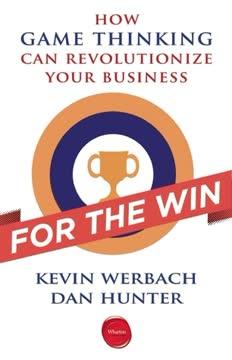
Get the complete 30-minute summary of For the Win
Get the complete summary in the appGamification is the use of game elements in non-game contexts, not the creation of full games.
Intrinsic motivation is more powerful and more sustainable than extrinsic motivation.
Extrinsic rewards can crowd out intrinsic motivation. Use them carefully.
Design for competence, relatedness, and autonomy.
Points, badges, and leaderboards are tools, not the whole story.
Design from the top down: dynamics first, then mechanics, then components.
"For the Win" is a strong fit if you want practical ideas around business, psychology, games, especially themes like gamification is the use of game elements in non-game contexts, not the creation of full games; intrinsic motivation is more powerful and more sustainable than extrinsic motivation. The MinuteRead summary distills these concepts into a focused read, whether you're deciding whether to buy the book or applying its lessons at work.
Kevin Werbach is a Professor of Legal Studies and Business Ethics at the Wharton School, University of Pennsylvania. He is also the founder of Supernova Group, a technology consulting firm. Werbach has extensive experience in communication policy, having advised both the Federal Communications Commission and the Department of Commerce. His expertise spans technology, business, and law, making him well-suited to address the multifaceted nature of gamification. Werbach is known for his work on gam…
View all summaries by Kevin WerbachContinue Reading
Access the complete 30-minute summary and thousands more nonfiction books in the MinuteRead app.

Continue reading the complete summary in the MinuteRead app.