 MinuteRead
30 min
Book summary
by Dave Gray
Premium summary · Opens in the app · 30 min read
The modern workplace is filled with meetings that don't work. People gather in conference rooms, stare at slides, nod politely, and leave with no clearer understanding than when they arrived. Decisions get made in hallways after the official meeting ends. Ideas die in email threads. The most talented people in an organization often feel unheard, while the loudest voices dominate every discussion.
**Author:** Dave Gray
**Estimated Reading Time:** 48 minutes
**What You'll Learn:**
- Why the rules of business have fundamentally changed and why old problem-solving methods no longer work - How to design game worlds that unlock creativity, collaboration, and breakthrough thinking - The three essential phases of every productive creative session: opening, exploring, and closing - A practical toolkit of games you can use immediately to transform meetings, workshops, and planning sessions - How to build your own custom games for any business challenge
**Who This Book Is For:**
This book is for anyone who leads teams, facilitates meetings, manages projects, or wrestles with complex problems that resist simple solutions. If you have ever sat through a brainstorming session that produced nothing useful, struggled to align a group around a decision, or felt that your organization's approach to problem-solving is stuck in the past, this book will give you a new way forward.
The modern workplace is filled with meetings that don't work. People gather in conference rooms, stare at slides, nod politely, and leave with no clearer understanding than when they arrived. Decisions get made in hallways after the official meeting ends. Ideas die in email threads. The most talented people in an organization often feel unheard, while the loudest voices dominate every discussion. This is not a small problem. It is a fundamental failure of how we approach knowledge work. For most of the twentieth century, business operated on a simple premise: work could be broken down into predictable, repeatable processes. The goal was efficiency. Standardize the process, measure the output, and optimize. This approach worked brilliantly for manufacturing physical products. It worked less well for managing information. And it fails almost completely when the goal is generating new ideas, solving novel problems, or navigating uncertainty. We are now living in what Dave Gray calls a new age of discovery. The challenges that matter most to organizations today are not problems with known solutions. They are ambiguous, shifting, and complex. They require creativity, not just execution. They require collaboration, not just coordination. And they require a fundamentally different approach to thinking together. The problem is that most organizations are still using tools designed for the industrial age. The meeting agenda, the PowerPoint presentation, the status report: these are artifacts of a world where the goal was to transmit information from those who had it to those who needed it. They were never designed to help groups think creatively, explore possibilities, or generate new knowledge. Gamestorming offers an alternative. The core insight is simple but profound: games are not just for children. Games are structured environments where people can explore ideas, test hypotheses, and discover new possibilities without the…
Continue reading in the MinuteRead app
Get the complete 30-minute summary of Gamestorming
Get the complete summary in the appEvery creative session has three phases: opening, exploring, and closing. Skipping any phase produces poor results.
Opening is about generating quantity without judgment. The best ideas often start out looking like bad ideas.
Exploring is about understanding. The first satisfying explanation is rarely the best one.
Closing is about making choices and committing to action. Avoiding hard choices is itself a choice, and usually a bad on
Games create possibility spaces where people can think differently, interact differently, and see differently.
Visual thinking is a learnable skill. The visual alphabet provides a simple foundation for drawing anything.
"Gamestorming" is a strong fit if you want practical ideas around business, design, management, especially themes like every creative session has three phases: opening, exploring, and closing. skipping any phase produces poor results; opening is about generating quantity without judgment. the best ideas often start out looking like bad ideas. The MinuteRead summary distills these concepts into a focused read, whether you're deciding whether to buy the book or applying its lessons at work.
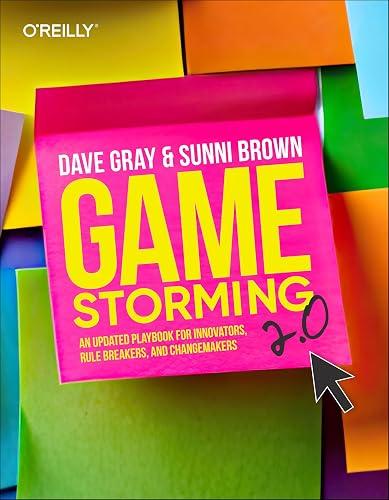
Motivated to help readers with about creating game worlds specifically to explore and examine business challenges, Dave Gray wrote “Gamestorming” to package those ideas for a fast, focused read. In “Gamestorming”, Dave Gray focuses on about creating game worlds specifically to explore and examine business challenges. Through “Gamestorming”, Dave Gray distills the core ideas on business into lessons readers can absorb in a single short sitting. Readers turn to this work when they want Dave Gray's…
Continue Reading
Access the complete 30-minute summary and thousands more nonfiction books in the MinuteRead app.

Continue reading the complete summary in the MinuteRead app.






