 MinuteRead
30 min
Book summary
Premium summary · Opens in the app · 30 min read
Every day, you make dozens of decisions. Some are small: which email to answer first, which meeting to accept, which task deserves your attention. Others are larger: whether to hire a candidate, how to allocate a budget, when to abandon a failing project. Most of these decisions happen quickly, guided by habit, intuition, and the pressure to keep moving.
**Author:** Harvard Business Review **Estimated Reading Time:** 45 minutes
**What You'll Learn:** - How to question assumptions without alienating colleagues - Practical frameworks for making better decisions under uncertainty - Techniques to recognize and counter your own cognitive biases - Methods to reframe problems and uncover innovative solutions - Ways to build critical thinking into your daily professional routine
**Who This Book Is For:** Professionals who want to move beyond reacting to problems and start solving them systematically. Whether you are an individual contributor aiming for leadership, a manager navigating complex decisions, or an executive responsible for strategic direction, this guide provides the mental tools to think more clearly, decide more confidently, and lead more effectively.
Every day, you make dozens of decisions. Some are small: which email to answer first, which meeting to accept, which task deserves your attention. Others are larger: whether to hire a candidate, how to allocate a budget, when to abandon a failing project. Most of these decisions happen quickly, guided by habit, intuition, and the pressure to keep moving. But here is the uncomfortable truth: the speed of modern work often works against the quality of your thinking. The constant flow of information, the expectation of immediate responses, and the complexity of problems that cross your desk all create conditions where shallow thinking thrives. You react instead of reflect. You accept the first plausible answer instead of probing deeper. You rely on what worked before, even when the situation has changed. This is why critical thinking has become one of the most valuable skills in the professional world. It is not an academic exercise or a talent reserved for philosophers. It is a practical discipline that helps you see clearly, decide wisely, and act with confidence. It is the difference between professionals who merely manage problems and those who solve them. The challenge is that critical thinking does not come naturally. Your brain is wired for efficiency, not accuracy. It takes shortcuts. It favors information that confirms what you already believe. It avoids the discomfort of uncertainty. It settles for good enough when better is available. These mental habits served your ancestors well when quick decisions meant survival, but they create real problems in a world where decisions have long-term consequences and complex ripple effects. The HBR Guide to Critical Thinking addresses this challenge directly. It brings together insights from leading thinkers, researchers, and practitioners who have studied how people make decisions, where thinking goes wrong, and what can be done to improve it. The result is a practical guide to thinking more carefully, questioning more effectively, and deciding more rationally. What makes this approach different is its emphasis on application. This is not…
Continue reading in the MinuteRead app
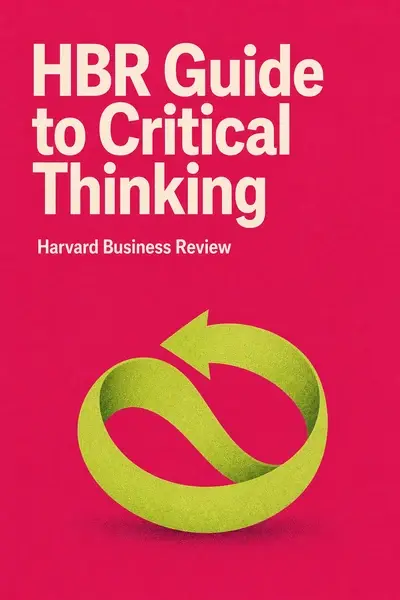
Get the complete 30-minute summary of HBR Guide to Critical Thinking
Get the complete summary in the appQuestion your assumptions. They shape your decisions, often without your awareness.
Embrace uncertainty. False certainty leads to brittle decisions that fail when conditions change.
Reframe problems. The way you frame a problem determines the solutions you can see.
Ask better questions. Open-ended questions reveal more than closed questions.
Seek diverse perspectives. You cannot see your own blind spots.
Manage your biases. Everyone is subject to them, and awareness alone is not enough.
"HBR Guide to Critical Thinking" is a strong fit if you want practical ideas around business, management, self help, especially themes like question your assumptions. they shape your decisions, often without your awareness; embrace uncertainty. false certainty leads to brittle decisions that fail when conditions change. The MinuteRead summary distills these concepts into a focused read, whether you're deciding whether to buy the book or applying its lessons at work.
Harvard Business Review is a general management magazine published by Harvard Business Publishing, a wholly-owned subsidiary of Harvard University. The magazine, which is published six times a year, is written for business executives and focuses on various management techniques and best practices. HBR is known for its rigorous selection process, publishing only about one percent of the roughly 4,000 manuscripts it receives annually. The magazine often features articles by leading business schola…
View all summaries by Harvard Business ReviewContinue Reading
Access the complete 30-minute summary and thousands more nonfiction books in the MinuteRead app.

Continue reading the complete summary in the MinuteRead app.






