 MinuteRead
30 min
Book summary
Premium summary · Opens in the app · 30 min read
The modern workplace has a problem that almost everyone feels but few can name. You sit down to focus on an important project. Within minutes, an email arrives. Then a message pings. Then a colleague stops by with a quick question. By the time you return to your original task, you have lost your train of thought. You check your phone. You remember another deadline. You start three things and finish none. By the end of the day, you are exhausted but cannot point to anything meaningful you accompl
**Author:** Harvard Business Review
**Estimated Reading Time:** 45 minutes
**What You'll Learn:**
* Why your brain feels overwhelmed and what to do about it * How to convert stress from an enemy into a performance tool * Why managing energy matters more than managing time * How to design a life that integrates work and home without constant conflict * Practical experiments you can run to reduce stress starting today
**Who This Book Is For:**
Professionals who feel stretched thin, managers who want to build healthier teams, and anyone who suspects that working harder is no longer working. If you have ever ended a busy day wondering what you actually accomplished, this book is for you.
The modern workplace has a problem that almost everyone feels but few can name. You sit down to focus on an important project. Within minutes, an email arrives. Then a message pings. Then a colleague stops by with a quick question. By the time you return to your original task, you have lost your train of thought. You check your phone. You remember another deadline. You start three things and finish none. By the end of the day, you are exhausted but cannot point to anything meaningful you accomplished. This is not laziness. It is not a character flaw. And it is not the inevitable cost of being ambitious. The Harvard Business Review Guide to Managing Stress at Work brings together research from psychologists, neuroscientists, organizational behavior experts, and leaders who have studied why modern work feels so overwhelming. Their findings point to a fundamental mismatch: the human brain evolved for a world of focused attention and manageable demands, but the modern workplace demands constant switching, endless availability, and perpetual urgency. The result is a condition that affects millions of professionals. Researchers call it Attention Deficit Trait, or ADT. Unlike Attention Deficit Disorder, which is genetic and present from childhood, ADT is caused entirely by the environment. It develops when the demands on your time and attention exceed your brain's capacity to process them. The symptoms look similar to ADD: distractibility, inner frenzy, impatience, difficulty staying organized, and trouble setting priorities. But the cause is different, and that means the solution is different too. ADT is not something you are born with. It is something your environment does to you. And because it is environmental, you can change it. The book addresses a deeper problem as well. For decades, the standard advice for workplace stress has been to manage your time better. Use a calendar. Set priorities. Say no more often. But time management assumes that time is the scarce resource. The research presented in this guide suggests something different. Time is finite, yes,…
Continue reading in the MinuteRead app
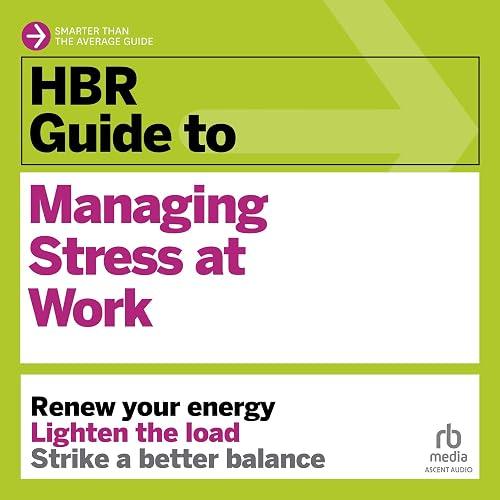
Get the complete 30-minute summary of HBR Guide to Managing Stress at Work
Get the complete summary in the app**Attention Deficit Trait is environmental.** The modern workplace causes distractibility and overwhelm. Change your env
**Stress can enhance performance.** Reframe stress as preparation for a challenge rather than a threat.
**Manage energy, not time.** Time is finite. Energy is renewable. Take breaks, sleep well, and cultivate positive emotio
**Sleep is non-negotiable.** Seven to eight hours per night is the foundation of cognitive performance.
**Integration beats balance.** Work and life are interconnected. Look for ways to blend them consciously.
**Small experiments create lasting change.** Try something new for two weeks. Evaluate. Adjust. Repeat.
"HBR Guide to Managing Stress at Work" is a strong fit if you want practical ideas around business, self help, leadership, especially themes like **attention deficit trait is environmental.** the modern workplace causes distractibility and overwhelm. change your env; **stress can enhance performance.** reframe stress as preparation for a challenge rather than a threat. The MinuteRead summary distills these concepts into a focused read, whether you're deciding whether to buy the book or applying its lessons at work.
Motivated to help readers with aDT is brought on by the demands on our time and attention that have exploded over the past two decades, Harvard Business Review wrote “HBR Guide to Managing Stress at Work” to package those ideas for a fast, focused read. In “HBR Guide to Managing Stress at Work”, Harvard Business Review focuses on aDT is brought on by the demands on our time and attention that have exploded over the past two decades. Through “HBR Guide to Managing Stress at Work”, Harvard Busines…
View all summaries by Harvard Business ReviewContinue Reading
Access the complete 30-minute summary and thousands more nonfiction books in the MinuteRead app.

Continue reading the complete summary in the MinuteRead app.






