 MinuteRead
30 min
Book summary
by Harvard Business Publishing
Premium summary · Opens in the app · 30 min read
Every leader eventually faces a moment when the old ways stop working. The strategies that built your career suddenly feel insufficient. The team that once followed you with enthusiasm now seems disengaged. The clarity you once had about where you were going has been replaced by a fog of competing priorities and endless demands.
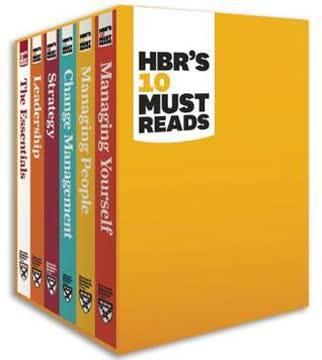
**HBR's 10 Must Reads Boxed Set**
*Essential Leadership Lessons from Harvard Business Review*
**Author:** Harvard Business Publishing
**Estimated Reading Time:** 45 minutes
**What You'll Learn:**
- How to access your best leadership self, even under pressure - Why clarity of vision matters more than charisma - How to align your time, energy, and actions with what truly matters - The disciplines that separate transformative leaders from merely competent managers - How to build teams that thrive long after you leave the room
**Who This Book Is For:**
This book is for anyone who carries responsibility for the performance of others. Whether you lead a small team, a growing company, or a global organization, the ideas here will help you lead with greater clarity, integrity, and impact. It is for the manager who feels stretched thin, the executive who suspects their strategy has drifted, and the emerging leader who wants to build a foundation that lasts.
Every leader eventually faces a moment when the old ways stop working. The strategies that built your career suddenly feel insufficient. The team that once followed you with enthusiasm now seems disengaged. The clarity you once had about where you were going has been replaced by a fog of competing priorities and endless demands. This is not a sign that you have failed. It is a sign that you have grown. The challenge is that most leadership advice does not meet you in this moment. It offers checklists and frameworks, tips and techniques. It tells you to be more strategic, more communicative, more decisive. But it rarely addresses the deeper question: How do you become the kind of leader who can navigate complexity without losing yourself in the process? The articles collected in this volume, drawn from the most influential writing published in Harvard Business Review, take a different approach. They do not pretend that leadership is a set of simple behaviors you can adopt overnight. Instead, they treat leadership as a discipline, a practice that requires self-awareness, intentionality, and the courage to act from your deepest values rather than your immediate comfort. The problem most leaders face is not a lack of knowledge. It is a lack of alignment. Your time does not match your priorities. Your actions do not reflect your values. Your communication does not convey your vision. Your leadership style does not express who you truly are. These gaps are not failures of competence. They are failures of attention. The authors represented here, thinkers like Robert Quinn, Peter Drucker, John Kotter, and others, have spent decades studying what actually distinguishes great leaders from average ones. Their findings are remarkably consistent. Great leaders are not necessarily more talented, more charismatic, or more…
Continue reading in the MinuteRead app
Get the complete 30-minute summary of HBR's 10 Must Reads Boxed Set (6 Books)
Get the complete summary in the appLeadership is a state you enter, not a position you hold. Choose the fundamental state deliberately.
Ask four questions: What result do I want to create? What do I believe is right? What do others need from me? What infor
Discover your strengths through feedback analysis. Build on strengths, not weaknesses.
Clarify your values with the mirror test. What kind of person do you want to see every morning?
Communicate your vision simply and consistently. Use every opportunity to reinforce the message.
Align your time with your priorities. Track your time, delegate low-priority tasks, and block out time for what matters.
"HBR's 10 Must Reads Boxed Set (6 Books)" is a strong fit if you want practical ideas around business, leadership, management, especially themes like leadership is a state you enter, not a position you hold. choose the fundamental state deliberately; ask four questions: what result do i want to create? what do i believe is right? what do others need from me? what infor. The MinuteRead summary distills these concepts into a focused read, whether you're deciding whether to buy the book or applying its lessons at work.
Harvard Business Review is a prestigious management magazine published by Harvard Business Publishing, a wholly-owned subsidiary of Harvard University. It features articles on various business topics, including leadership, strategy, and innovation. The publication is known for its practical insights and research-based content, aimed at helping managers and executives improve their skills and decision-making. HBR's Must Reads series compiles some of the most influential articles from the magazine…
View all summaries by Harvard Business PublishingContinue Reading
Access the complete 30-minute summary and thousands more nonfiction books in the MinuteRead app.

Continue reading the complete summary in the MinuteRead app.






