MinuteRead
30 min
Book summary
Premium summary · Opens in the app · 30 min read
Most people think advertising is about lying. They believe clever people sit in fancy offices dreaming up ways to trick the public into buying things they do not need. There is some truth to the stereotype. The industry has produced its share of deception, bad taste, and waste.
**Author:** Luke Sullivan
**Estimated Reading Time:** 45 minutes
**What You'll Learn:**
- Why creativity in advertising is a disciplined craft, not a mysterious gift - How to find the simple idea at the heart of every great campaign - Why visual thinking often beats verbal cleverness - How to protect good work from bad feedback - What it takes to build a portfolio that gets you hired - How to survive and thrive in a demanding, often chaotic industry
**Who This Book Is For:**
Anyone who creates messages for a living. Copywriters, art directors, designers, marketers, brand managers, and students trying to break into the business. It is also for people who simply want to understand why some ads stick in their heads for decades while others vanish the moment they appear.
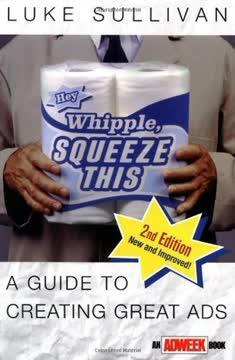
Most people think advertising is about lying. They believe clever people sit in fancy offices dreaming up ways to trick the public into buying things they do not need. There is some truth to the stereotype. The industry has produced its share of deception, bad taste, and waste. But that is not what this book is about. Luke Sullivan wrote *Hey Whipple, Squeeze This* to show the other side of advertising. The side where craft matters. Where a well-chosen word can change how millions of people think about a product. Where a single image can capture an idea more powerfully than a thousand-word essay. Where creativity, discipline, and strategic thinking combine to create work that people actually enjoy. The title comes from an old Charmin toilet paper campaign featuring Mr. Whipple, a fussy grocer who begged shoppers not to squeeze the product. It was annoying. It was repetitive. It ran for decades. And it became a symbol of everything wrong with advertising: the assumption that if you repeat something often enough, people will buy it. Sullivan uses Mr. Whipple as a warning. Do not create work like that. Do not settle for the obvious, the safe, the forgettable. Instead, aim for work that respects the audience's intelligence. Work that makes people laugh, think, or feel something. Work that actually works. The problem most advertisers face is not a lack of ideas. It is a lack of clarity. They try to say too much. They bury the core message under layers of cleverness. They confuse activity with progress. They mistake novelty for creativity. Sullivan's approach is different. He argues that great advertising comes from a process. Not a mystical process that only geniuses can access, but a repeatable, learnable method that anyone can master with practice. The process involves understanding the product deeply, finding the simple truth at its core, generating many ideas, killing most of them, and refining…
Continue reading in the MinuteRead app
Get the complete 30-minute summary of Hey Whipple, Squeeze This
Get the complete summary in the appCreativity is a process, not a gift. Learn the process and you can produce good work on demand.
Find the simple truth at the core of your product. Express it in a single, clear sentence.
Images communicate faster than words. Think visually before you think verbally.
Cut ruthlessly. Most copy is too long. Most ideas are too complicated.
Push past the first idea. The obvious solution is rarely the best one.
Build a portfolio that showcases quality over quantity. Include work for boring products.
"Hey Whipple, Squeeze This" is a strong fit if you want practical ideas around business, writing, design, especially themes like creativity is a process, not a gift. learn the process and you can produce good work on demand; find the simple truth at the core of your product. express it in a single, clear sentence. The MinuteRead summary distills these concepts into a focused read, whether you're deciding whether to buy the book or applying its lessons at work.
Luke Sullivan is a renowned advertising professional and author with extensive experience in the industry. He has worked as a copywriter and creative director at several top agencies, contributing to numerous successful campaigns. Sullivan is known for his witty and straightforward approach to teaching advertising principles. His expertise spans various media, from traditional print and broadcast to digital platforms. Sullivan's insights are rooted in practical experience, making his advice part…
View all summaries by Luke SullivanContinue Reading
Access the complete 30-minute summary and thousands more nonfiction books in the MinuteRead app.

Continue reading the complete summary in the MinuteRead app.