MinuteRead
30 min
Book summary
Premium summary · Opens in the app · 30 min read
Every day, organizations make significant decisions about cybersecurity with almost no quantitative basis. They spend millions on controls, accept or reject risks, and report to boards using color-coded charts that convey almost no useful information. The standard tools of the trade are heat maps, risk matrices, and ordinal scales that label risks as high, medium, or low. These tools feel rigorous. They produce a sense of order. But they are nearly useless for making actual decisions.
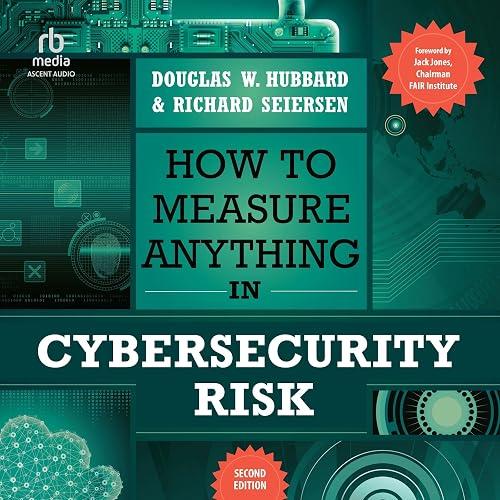
**Author:** Douglas W. Hubbard
**Estimated Reading Time:** 45 minutes
**What You'll Learn:**
- Why the belief that cybersecurity risk cannot be measured is false - How to quantify uncertainty using surprisingly small amounts of data - How to calibrate expert judgment to produce reliable probability estimates - How to use Bayesian methods, Monte Carlo simulations, and loss exceedance curves - How to build a data-driven cybersecurity risk management program
**Who This Book Is For:**
- Security professionals frustrated by vague risk matrices and traffic light charts - Executives who need defensible numbers to justify security investments - Risk managers seeking better tools for decision-making under uncertainty - Anyone who has been told that cybersecurity risk is too complex to quantify
Every day, organizations make significant decisions about cybersecurity with almost no quantitative basis. They spend millions on controls, accept or reject risks, and report to boards using color-coded charts that convey almost no useful information. The standard tools of the trade are heat maps, risk matrices, and ordinal scales that label risks as high, medium, or low. These tools feel rigorous. They produce a sense of order. But they are nearly useless for making actual decisions. The problem is not a lack of data. The problem is a widespread belief that cybersecurity risk belongs to a special category of things that cannot be measured. This belief is so deeply embedded in the profession that many practitioners have stopped trying. They assume that because cyber threats are complex, fast-moving, and often hidden, quantitative measurement is impossible. They settle for qualitative judgments dressed up as analysis. Douglas W. Hubbard has spent his career confronting exactly this kind of thinking. His earlier work, How to Measure Anything, made the case that virtually any quantity of interest to business can be measured, including intangibles like brand value, employee morale, and customer satisfaction. In this book, he turns his attention to cybersecurity risk, a field where the resistance to measurement is particularly strong. Hubbard's central argument is simple and provocative: you have more data than you think, and you need less data than you think. The barrier to measuring cybersecurity risk is not technical. It is conceptual. Once you accept that measurement is about reducing uncertainty rather than achieving perfect precision, the entire field opens up. Consider what measurement actually means. Many people confuse measurement with exactness. They imagine that unless you can produce a number with several decimal places, you have not measured anything. But measurement, properly understood, is any observation that reduces uncertainty about a quantity. If you previously thought a breach would cost somewhere between $100,000 and $10 million, and new information narrows that range to between $500,000 and $2 million, you…
Continue reading in the MinuteRead app
Get the complete 30-minute summary of How to Measure Anything in Cybersecurity Risk
Get the complete summary in the appMeasurement is uncertainty reduction, not the elimination of uncertainty.
You have more data than you think and need less than you think.
Calibration training turns expert judgment into reliable data.
Decomposition makes complex risks manageable.
Bayesian updating allows you to learn from new information systematically.
Monte Carlo simulation reveals the full range of possible outcomes.
"How to Measure Anything in Cybersecurity Risk" is a strong fit if you want practical ideas around business, technology, computer science, especially themes like measurement is uncertainty reduction, not the elimination of uncertainty; you have more data than you think and need less than you think. The MinuteRead summary distills these concepts into a focused read, whether you're deciding whether to buy the book or applying its lessons at work.
Motivated to help readers with you have more data than you think and need less than you think, Douglas W. Hubbard wrote “How to Measure Anything in Cybersecurity Risk” to package those ideas for a fast, focused read. In “How to Measure Anything in Cybersecurity Risk”, Douglas W. Hubbard focuses on you have more data than you think and need less than you think. Through “How to Measure Anything in Cybersecurity Risk”, Douglas W. Hubbard distills the core ideas on business into lessons readers can …
View all summaries by Douglas W. HubbardContinue Reading
Access the complete 30-minute summary and thousands more nonfiction books in the MinuteRead app.

Continue reading the complete summary in the MinuteRead app.