 MinuteRead
30 min
Book summary
Premium summary · Opens in the app · 30 min read
In the late 1990s, a strange question began circulating through the hallways of Microsoft's headquarters in Redmond, Washington. It was not a question about programming languages, management philosophy, or career goals. It was this: "How would you move Mount Fuji?"
**Author:** William Poundstone
**Estimated Reading Time:** 45 minutes
**What You'll Learn:**
- Why the world's most innovative companies abandoned traditional interviews - The hidden logic behind impossible interview questions - How puzzle interviews reveal creative thinking that resumes cannot - The cognitive science behind why some people solve problems others cannot - Practical strategies for navigating brainteaser interviews - What these puzzles reveal about intelligence, innovation, and human potential
**Who This Book Is For:**
This book is for anyone who has ever faced an impossible question in a job interview, anyone who hires people and wonders if there is a better way, and anyone curious about how the world's most successful companies identify creative talent. It is also for puzzle enthusiasts who want to understand why certain problems stump even brilliant minds.
In the late 1990s, a strange question began circulating through the hallways of Microsoft's headquarters in Redmond, Washington. It was not a question about programming languages, management philosophy, or career goals. It was this: "How would you move Mount Fuji?" The question became legendary. It spread through Silicon Valley, then to Wall Street, then to consulting firms and law offices across America. Soon, job candidates everywhere were being asked to estimate the number of piano tuners in the world, to explain why manhole covers are round, or to figure out how to escape from a blender. To outsiders, these questions seemed absurd. What possible relevance could moving a mountain have to writing software? Why would an investment bank care how many gas stations exist in the United States? The questions appeared to be a form of hazing, a way for companies to make smart people feel stupid. But William Poundstone saw something deeper happening. These puzzle interviews represented a fundamental shift in how companies think about talent. The old model of hiring was built on credentials: where you went to school, what grades you earned, what skills you already possessed. The new model was built on something harder to measure but potentially more valuable: the ability to think through problems you have never seen before. The logic was simple. In a fast-changing industry, specific knowledge becomes obsolete quickly. The programming language you mastered in college might be irrelevant five years later. The market conditions you studied might shift overnight. What remains valuable is the capacity to confront novel situations, to reason through ambiguity, to find creative solutions when no established answer exists. Microsoft's puzzle interviews were designed to test exactly that capacity. When an interviewer asked how you would move Mount Fuji, they did not care whether you knew anything about mountains, construction equipment, or Japanese geography. They cared about how your mind worked when faced with a…
Continue reading in the MinuteRead app
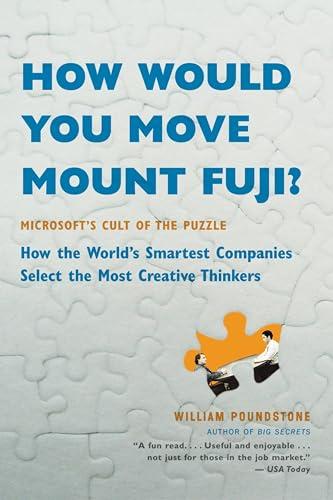
Get the complete 30-minute summary of How Would You Move Mount Fuji? Microsoft's Cult of the Puzzle--How the World's Smartest Companies Select the Most Creative Thinkers
Get the complete summary in the appPuzzle interviews test reasoning ability, not knowledge. The interviewer wants to see how you think, not what you know.
The process matters more than the answer. A well-reasoned approach is more impressive than a correct guess.
Question your assumptions. The key to many puzzles lies in questioning an assumption you did not know you were making.
Generate multiple approaches before committing to one. Fixation on a single idea is a common obstacle to insight.
Simple solutions are often the best. Do not assume that a problem is harder than it is.
Clueless plateaus are normal. Being stuck is a phase of the process, not a sign of failure.
"How Would You Move Mount Fuji? Microsoft's Cult of the Puzzle--How the World's Smartest Companies Select the Most Creative Thinkers" is a strong fit if you want practical ideas around business, management, psychology, especially themes like puzzle interviews test reasoning ability, not knowledge. the interviewer wants to see how you think, not what you know; the process matters more than the answer. a well-reasoned approach is more impressive than a correct guess. The MinuteRead summary distills these concepts into a focused read, whether you're deciding whether to buy the book or applying its lessons at work.
Motivated to help readers with microsoft’s interview process is a notoriously grueling sequence of brain-busting questions that separate the, William Poundstone wrote “How Would You Move Mount Fuji? Microsoft's Cult of the Puzzle--How the World's Smartest Companies Select the Most Creative Thinkers” to package those ideas for a fast, focused read. In “How Would You Move Mount Fuji? Microsoft's Cult of the Puzzle--How the World's Smartest Companies Select the Most Creative Thinkers”, William Poun…
View all summaries by William PoundstoneContinue Reading
Access the complete 30-minute summary and thousands more nonfiction books in the MinuteRead app.

Continue reading the complete summary in the MinuteRead app.






