 MinuteRead
30 min
Book summary
by Matthew E. May
Premium summary · Opens in the app · 30 min read
We live in a world that celebrates addition. More features. More options. More information. More speed. When something is not working, our first instinct is to add something to fix it. When a product fails to sell, we add features. When a message fails to land, we add words. When a strategy fails to deliver, we add complexity.
**Author:** Matthew E. May **Estimated Reading Time:** 45 minutes
Why the most powerful solutions are often the simplest ones. How subtraction beats addition in nearly every creative endeavor. What makes certain designs, products, and ideas feel inevitable. Why constraints fuel innovation rather than hinder it. How to cultivate the observation skills that lead to breakthrough insights. What the world's most elegant solutions have in common across art, business, technology, and daily life.
Anyone who has ever felt overwhelmed by complexity. Designers, entrepreneurs, managers, and creators who want to produce work that feels effortless and inevitable. People who suspect that doing more is not the same as achieving more. Readers who appreciate the power of restraint and want to understand how to apply it systematically.
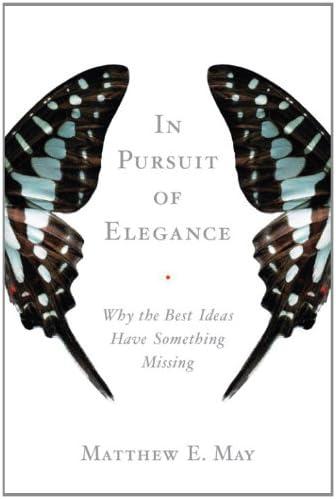
We live in a world that celebrates addition. More features. More options. More information. More speed. When something is not working, our first instinct is to add something to fix it. When a product fails to sell, we add features. When a message fails to land, we add words. When a strategy fails to deliver, we add complexity. This instinct is deeply human. It is also deeply flawed. Consider the last time you encountered something truly elegant. A product that felt effortless to use. A solution that seemed obvious once you saw it. A piece of communication that stopped you in your tracks with its clarity. What made it work was almost certainly not how much was included but how much was left out. Matthew E. May wrote *In Pursuit of Elegance* to explore a simple but profound question: What makes certain solutions feel inevitable? Why do some designs, ideas, and strategies resonate so deeply that they seem to have always existed, while others feel clunky, forced, and forgettable? The answer, he discovered, is not what most of us have been taught to believe. Elegance is not about decoration. It is not about luxury. It is not about making things pretty. Elegance is about achieving the maximum impact with the minimum means. It is the art of subtraction. It is the discipline of leaving things out. It is the courage to stop before you have added too much. This idea has ancient roots. The Chinese philosopher Lao Tzu wrote about it more than two thousand years ago. The Renaissance masters understood it. Great scientists have described their most important discoveries in these terms. Yet in our modern world of abundance, we have largely forgotten this wisdom. We have convinced ourselves that more is better. That complexity signals sophistication. That if we just add one more feature, one more step, one more option, we will finally get it right. The result is a world drowning in clutter.…
Continue reading in the MinuteRead app
Get the complete 30-minute summary of In Pursuit of Elegance
Get the complete summary in the appSubtract before you add. The path to better is through less.
Elegance is simplicity with depth, not simplicity for its own sake.
Constraints breed creativity. Embrace limitations as opportunities.
Observe deeply before designing. Understanding the problem is more important than finding the solution.
Mental breaks are not laziness. They are essential for insight.
Symmetry creates order in chaos. Look for patterns beneath the surface.
"In Pursuit of Elegance" is a strong fit if you want practical ideas around business, design, psychology, especially themes like subtract before you add. the path to better is through less; elegance is simplicity with depth, not simplicity for its own sake. The MinuteRead summary distills these concepts into a focused read, whether you're deciding whether to buy the book or applying its lessons at work.
Motivated to help readers with "Perfection is achieved not when there is nothing more to add, Matthew E. May wrote “In Pursuit of Elegance” to package those ideas for a fast, focused read. In “In Pursuit of Elegance”, Matthew E. May focuses on "Perfection is achieved not when there is nothing more to add. Through “In Pursuit of Elegance”, Matthew E. May distills the core ideas on business into lessons readers can absorb in a single short sitting. Readers turn to this work when they want Matthew …
Continue Reading
Access the complete 30-minute summary and thousands more nonfiction books in the MinuteRead app.

Continue reading the complete summary in the MinuteRead app.






