 MinuteRead
30 min
Book summary
by Bernard Marr
Premium summary · Opens in the app · 30 min read
Every business sits on top of an ocean of information. Sales figures, customer feedback, operational metrics, financial reports, employee surveys. The data is there, flowing through spreadsheets, databases, and dashboards. Yet most organizations are not information-poor. They are insight-poor. They collect enormous amounts of data but struggle to answer the simplest and most important question: How are we actually doing?
**Author:** Bernard Marr
**Estimated Reading Time:** 52 minutes
**What You'll Learn:**
* Why most organizations measure the wrong things and how to fix it * A complete system for developing KPIs that actually drive performance * How to organize metrics so they tell a coherent story about your business * The specific KPIs that matter for finance, customers, operations, and people * How to turn measurement into better decisions and lasting change
**Who This Book Is For:**
This book is for managers, business owners, analysts, and leaders who are tired of drowning in data without gaining clarity. If you have ever looked at a dashboard full of numbers and wondered what any of it means for your business, this book will change how you think about measurement. It is also for anyone responsible for strategy execution, performance improvement, or organizational change who wants a practical, jargon-free guide to building a measurement system that works.
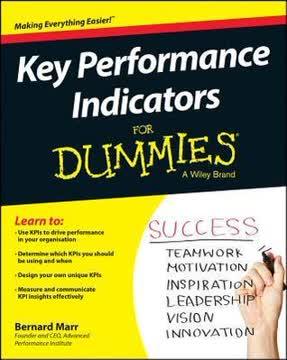
Every business sits on top of an ocean of information. Sales figures, customer feedback, operational metrics, financial reports, employee surveys. The data is there, flowing through spreadsheets, databases, and dashboards. Yet most organizations are not information-poor. They are insight-poor. They collect enormous amounts of data but struggle to answer the simplest and most important question: How are we actually doing? This is the problem Bernard Marr set out to solve in Key Performance Indicators For Dummies. The book exists because measurement, despite being fundamental to business success, is widely misunderstood and poorly executed. Companies measure too much or too little. They measure what is easy rather than what matters. They collect metrics that look impressive in board presentations but fail to inform any real decision. They build elaborate dashboards that nobody reads and reports that nobody acts upon. The cost of this failure is enormous. When organizations lack meaningful performance indicators, they fly blind. They discover problems too late. They invest in initiatives without knowing whether those initiatives are working. They argue about opinions when they should be examining evidence. They repeat mistakes because they never identified what went wrong in the first place. In short, they navigate the competitive landscape without a compass. Marr's central insight is that KPIs are not just numbers. They are navigation tools. A well-designed KPI tells you where you are, where you are heading, and whether you need to change course. It reduces the overwhelming complexity of organizational performance to a small set of signals that demand attention. It transforms raw data into actionable insight. The challenge is that most organizations approach KPIs backwards. They start with the data they already have and try to find meaning in it. They copy metrics from competitors or industry benchmarks without asking whether…
Continue reading in the MinuteRead app
Get the complete 30-minute summary of Key Performance Indicators For Dummies
Get the complete summary in the appKPIs are navigation tools that tell you where you are and where you are heading.
Start with strategy, not data. Identify the questions that matter before selecting metrics.
Every KPI should answer a specific question and inform a specific decision.
Focus on the vital few metrics that matter, not everything that can be measured.
The purpose of measurement is learning and improvement, not punishment.
Use a framework like the Balanced Scorecard to organize KPIs into a coherent picture.
"Key Performance Indicators For Dummies" is a strong fit if you want practical ideas around business, reference, especially themes like kpis are navigation tools that tell you where you are and where you are heading; start with strategy, not data. identify the questions that matter before selecting metrics. The MinuteRead summary distills these concepts into a focused read, whether you're deciding whether to buy the book or applying its lessons at work.
Bernard Marr is a renowned figure in the business and data world. As a best-selling author, he has established himself as a leading expert in performance management and business analytics. Marr's expertise extends beyond writing, as he is also a sought-after keynote speaker, sharing his insights with audiences worldwide. His work focuses on helping organizations leverage data and analytics to improve their performance and make better decisions. Marr's ability to communicate complex concepts in a…
View all summaries by Bernard MarrContinue Reading
Access the complete 30-minute summary and thousands more nonfiction books in the MinuteRead app.

Continue reading the complete summary in the MinuteRead app.






