MinuteRead
5 min
Book summary
by Karen J. Bun
Premium summary · Opens in the app · 5 min read
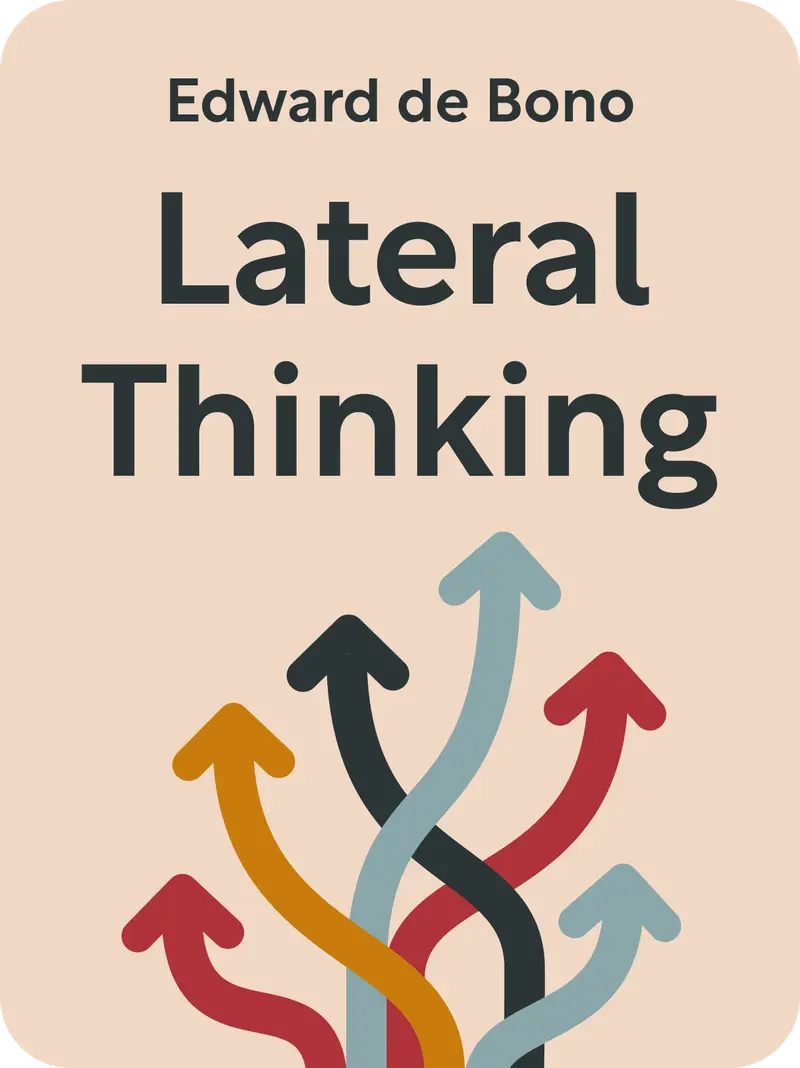
Lateral Thinking brings forth a new approach to the problem-solving process by proving how creativity and ditching vertical thinking can enhance the brain’s efficiency and make it find new ways of looking at a problem from new, innovative angles and outside-the-box perspectives.
Lateral Thinking brings forth a new approach to the problem-solving process by proving how creativity and ditching vertical thinking can enhance the brain’s efficiency and make it find new ways of looking at a problem from new, innovative angles and outside-the-box perspectives.
Growing up, society tells us that there are essentially two types of people. There are the ones that prefer numbers and the ones that prefer artistic or creative fields. Certainly, this assumption is not completely untrue, but it can do more damage than good. People from either category tend to focus on their native inclinations while ignoring the other completely.
Our world as we know it is based on vertical thinking. Everything revolves around data and facts. However, creative processes are essential for human development, so we ought to learn how to think laterally. If you’re the vertical thinking type, it can be harder to do so. But actively challenging your beliefs and looking at a problem in a non-conventional manner is what you should do.
Lateral thinking implies looking for alternatives to start your chain of thoughts. Instead of basing it on science and facts, look for fresh perspectives in your mind. Set a quota if you need to, and try to think of two, three, or five new ideas for your problem. However, it’s important to know when to use this type of thinking. When there’s a proven solution for an issue, such as a firefighter battling fire with water, there’s no need to jump far from this approach.
Still, lateral thinking is particularly important when constructing strategies, coming up with visions, or challenging the old ways of dealing with an issue. When doing so, it’s important to conduct brainstorming sessions. You can do this by yourself or with a team. And validate every answer you get. If you start responding negatively to a certain solution, even though it may seem absurd, your brain will shut down the creative process and retreat to old patterns instead.
Brainstorming is one of the most effective ways of solving a problem creatively. By teaming up with other people and sharing ideas in a constructive environment, there’s a strong chance that an innovative solution will pop up. The first stage of a brainstorming session is sharing ideas in a non-judgemental manner. Then, the selection process starts. We highlight the dominating ideas and then the process focuses on them. This lateral thinking form of thought is great for coming up with fresh perspectives for a problem. However, there is another way of addressing issues – through the reversal technique. Instead of looking for the cause-effect model, reverse them. For example, you could say “the parents are educating their kids” or “the…
Continue reading in the MinuteRead app
Get the complete 5-minute summary of Lateral Thinking
Get the complete summary in the appEveryone can learn lateral thinking, although they have an inclination for data and facts.
Along with brainstorming, the reversal method is great for solving problems.
The random exposure and the formal generation techniques to develop your lateral thinking.
"Lateral Thinking" is a strong fit if you want practical ideas around creativity, mindfulness, productivity, especially themes like everyone can learn lateral thinking, although they have an inclination for data and facts; along with brainstorming, the reversal method is great for solving problems. The MinuteRead summary distills these concepts into a focused read, whether you're deciding whether to buy the book or applying its lessons at work.
Motivated to help readers with lateral Thinking brings forth a new approach to the problem-solving process by proving how creativity and, ditching vertical thinking to find new ways of looking at a problem wrote “Lateral Thinking” to package those ideas for a fast, focused read. In “Lateral Thinking”, ditching vertical thinking to find new ways of looking at a problem focuses on lateral Thinking brings forth a new approach to the problem-solving process by proving how creativity and. Through “La…
View all summaries by Karen J. BunContinue Reading
Access the complete 5-minute summary and thousands more nonfiction books in the MinuteRead app.

Continue reading the complete summary in the MinuteRead app.