 MinuteRead
30 min
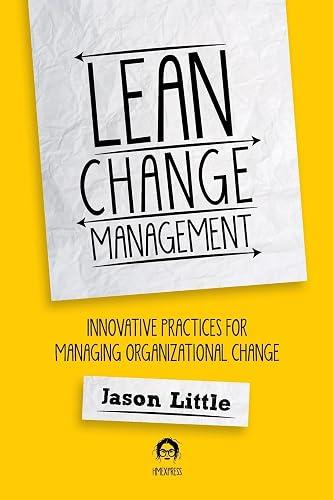
Book summary
by Jason Little
Premium summary · Opens in the app · 30 min read
Every organization faces change. New strategies, new technologies, new processes, new leadership. The question is not whether change will happen, but how well people will navigate it.
**Author:** Jason Little **Estimated Reading Time:** 42 minutes
Why traditional change management fails in modern organizations, how to treat organizational change as a series of experiments rather than a fixed plan, and practical tools for gathering insights, generating options, and building momentum through co-creation and feedback.
Change agents, managers, Agile coaches, HR professionals, and anyone responsible for helping organizations adapt. If you have ever felt frustrated by rigid change plans that collapse on contact with reality, this book offers a different path.
Every organization faces change. New strategies, new technologies, new processes, new leadership. The question is not whether change will happen, but how well people will navigate it. For decades, organizations have relied on traditional change management approaches. These approaches assume a predictable world. They begin with a detailed assessment, followed by an elaborate plan, followed by a carefully managed rollout. The underlying belief is that if you plan thoroughly enough and communicate clearly enough, you can guide people through change in an orderly fashion. Then reality intervenes. People react unpredictably. Hidden resistance surfaces. Assumptions prove wrong. The plan, so elegant on paper, starts to crumble. Change agents find themselves spending more time defending the plan than responding to what is actually happening. The result is frustration, wasted effort, and change initiatives that limp to completion or quietly die. Jason Little wrote Lean Change Management because he lived this frustration. Starting his career as a web developer, he moved into management and Agile coaching. Along the way, he noticed something curious. Agile adoption efforts often failed not because the practices were wrong, but because the change management around them was broken. Teams learned new methods, but the organization around them stayed the same. Old incentives persisted. Old habits reasserted themselves. Within months, the transformation stalled. The problem, Little realized, was not a lack of effort. It was a flawed mental model. Traditional change management treats change as something to be controlled. But change, especially in complex organizations, cannot be controlled. It can only be navigated. This insight led Little to explore alternatives. He drew from Lean Startup thinking, Agile principles, and his own experience coaching organizations through difficult transitions. The result is an approach that treats change as a continuous cycle of learning and adaptation rather than a linear process with a fixed endpoint. The core message is simple: try as you may, change cannot be controlled. Change is messy. The organizations that succeed are not the ones with the most detailed plans. They are the ones that learn fastest, adapt most readily, and involve the right people at the right time. This book is for anyone who has felt the gap between a beautiful change plan and the…
Continue reading in the MinuteRead app
Get the complete 30-minute summary of Lean Change Management
Get the complete summary in the appChange cannot be controlled. Treat it as a learning process, not a fixed plan.
Use the Lean Change Cycle: collect Insights, generate Options, run Experiments, repeat.
Collect insights before taking action. Talk to people, observe, and use structured tools to understand the current state
Generate multiple options and evaluate them based on cost, value, and disruption.
Treat every change as an experiment with a clear hypothesis and small-scale test.
Use visual tools like canvases to facilitate conversations and create shared understanding.
"Lean Change Management" is a strong fit if you want practical ideas around business, leadership, psychology, especially themes like change cannot be controlled. treat it as a learning process, not a fixed plan; use the lean change cycle: collect insights, generate options, run experiments, repeat. The MinuteRead summary distills these concepts into a focused read, whether you're deciding whether to buy the book or applying its lessons at work.
Motivated to help readers with "Try as you may, Jason Little wrote “Lean Change Management” to package those ideas for a fast, focused read. In “Lean Change Management”, Jason Little focuses on "Try as you may. Through “Lean Change Management”, Jason Little distills the core ideas on business into lessons readers can absorb in a single short sitting. Readers turn to this work when they want Jason Little's perspective on the subject without working through the entire original volume. Jason Palmer…
Continue Reading
Access the complete 30-minute summary and thousands more nonfiction books in the MinuteRead app.

Continue reading the complete summary in the MinuteRead app.






