MinuteRead
30 min
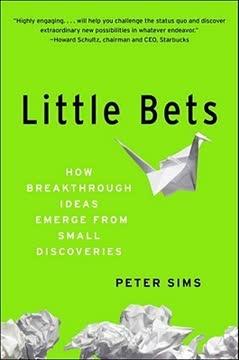
Book summary
by Peter Sims
Premium summary · Opens in the app · 30 min read
Most of us were taught to think before we act. Plan carefully. Analyze thoroughly. Develop a comprehensive strategy. Then, and only then, execute with confidence. This approach works beautifully in stable, predictable environments where the variables are known and the outcomes can be forecast with reasonable accuracy. But what happens when you face a problem that has never been solved before? What do you do when the terrain is unfamiliar, the rules are unclear, and the stakes are high?
**Author:** Peter Sims
**Estimated Reading Time:** 45 minutes
**What You'll Learn:**
- Why small, experimental actions outperform grand strategic plans in uncertain environments - How comedians, architects, military leaders, and tech entrepreneurs discover breakthrough ideas - The core methods for testing ideas cheaply, learning quickly, and building momentum - How to cultivate a mindset that treats failure as information rather than defeat - Practical ways to apply experimental innovation in your own work and life
**Who This Book Is For:**
Anyone who faces uncertainty in their creative, professional, or personal life. Whether you are an entrepreneur testing a new product, a manager seeking better ways to lead teams, an artist developing new work, or someone who simply wants to approach problems with more flexibility and resilience, this book provides a practical philosophy for making progress when the path forward is unclear.
Most of us were taught to think before we act. Plan carefully. Analyze thoroughly. Develop a comprehensive strategy. Then, and only then, execute with confidence. This approach works beautifully in stable, predictable environments where the variables are known and the outcomes can be forecast with reasonable accuracy. But what happens when you face a problem that has never been solved before? What do you do when the terrain is unfamiliar, the rules are unclear, and the stakes are high? This is the situation that increasingly defines modern work and life. Entrepreneurs launch products into markets that did not exist five years ago. Managers lead teams through organizational changes that have no precedent. Artists and writers attempt to create work that resonates in a cultural landscape that shifts by the month. In each of these cases, the old model of plan-then-execute breaks down. You cannot analyze your way to certainty when the future is fundamentally unknowable. Peter Sims wrote *Little Bets* to address this exact challenge. The book emerged from his observation that many of the most successful creative people and innovators in the world do not operate according to the conventional wisdom about planning and execution. Instead, they use a fundamentally different approach. They make small, concrete, affordable actions to discover what works. They treat ideas not as finished products to be defended, but as hypotheses to be tested. They expect to be wrong much of the time, and they have built methods for turning being wrong into a competitive advantage. Sims spent years studying how breakthrough ideas actually emerge. He interviewed comedians like Chris Rock, who test new material in tiny clubs before performing in arenas. He examined how Pixar develops films through thousands of small iterations rather than a single master plan. He studied how architect Frank Gehry uses rough sketches and physical models to discover designs…
Continue reading in the MinuteRead app
Get the complete 30-minute summary of Little Bets
Get the complete summary in the appMake little bets: small, affordable actions that generate information and guide your next step.
Fail fast to learn fast: design cheap experiments and extract lessons from every failure.
Cultivate a growth mindset: believe that abilities can be developed through effort and learning.
Foster playfulness: create an environment where ideas can grow without fear of judgment.
Find the right problem: question assumptions and reframe challenges before solving them.
Immerse yourself: observe reality directly to uncover insights that analysis cannot reveal.
"Little Bets" is a strong fit if you want practical ideas around business, psychology, self help, especially themes like make little bets: small, affordable actions that generate information and guide your next step; fail fast to learn fast: design cheap experiments and extract lessons from every failure. The MinuteRead summary distills these concepts into a focused read, whether you're deciding whether to buy the book or applying its lessons at work.
Peter Sims is an author, speaker, and entrepreneur known for his work on innovation and creativity. He studied at Bowdoin College and Stanford Business School. Peter Sims has experience in various ventures and leadership roles, which informs his writing. His approach emphasizes learning from failures and taking small, calculated risks. Sims is described as part of a global community of creative thinkers who aim to unlock inner creativity in others. His writing style is noted for its authenticity…
View all summaries by Peter SimsContinue Reading
Access the complete 30-minute summary and thousands more nonfiction books in the MinuteRead app.

Continue reading the complete summary in the MinuteRead app.