 MinuteRead
30 min
Book summary
Premium summary · Opens in the app · 30 min read
Every year, organizations spend enormous amounts of time, money, and intellectual energy crafting strategies. They hire consultants, conduct market analyses, run executive retreats, and produce thick planning documents filled with compelling visions and ambitious targets. Then, in far too many cases, nothing meaningful changes. The strategy sits on a shelf. The organization continues doing what it always did. The promised transformation never arrives.
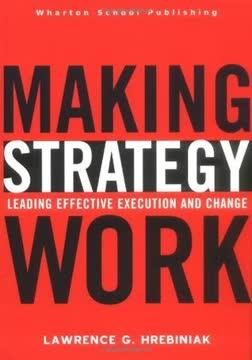
**Author:** Lawrence G. Hrebiniak
**Estimated Reading Time:** 45 minutes
**What You'll Learn:**
- Why execution fails more often than strategy formulation - How to build a complete execution framework that aligns structure, culture, incentives, and people - How to translate long-term strategy into short-term operational objectives - How to manage change, power, and resistance during implementation - How to apply execution principles across global, service, and project-based organizations
**Who This Book Is For:**
Leaders who are tired of beautiful strategies that never produce results. Managers who inherit strategic plans and wonder how to turn them into daily work. Executives who recognize that the gap between planning and doing is where organizations win or lose. Anyone responsible for making ambitious goals become operational reality.
Every year, organizations spend enormous amounts of time, money, and intellectual energy crafting strategies. They hire consultants, conduct market analyses, run executive retreats, and produce thick planning documents filled with compelling visions and ambitious targets. Then, in far too many cases, nothing meaningful changes. The strategy sits on a shelf. The organization continues doing what it always did. The promised transformation never arrives. This is not a secret. Most executives know that execution is where strategies go to die. What is less understood is why execution fails so consistently, and what can be done about it. Lawrence Hrebiniak, a professor at the Wharton School who has studied strategy implementation since the 1980s, argues that the problem is not a lack of effort or intention. The problem is that execution is genuinely harder than formulation, and most organizations underestimate its complexity. Formulating strategy is an intellectual exercise. It happens in conference rooms, among a small group of senior leaders, with relatively few variables to manage. Execution, by contrast, involves the entire organization. It requires coordinating hundreds or thousands of people across departments, functions, and geographies. It demands changes to structures, systems, processes, incentives, and culture. It takes far longer than planning, and it encounters far more resistance. Hrebiniak's central insight is that execution is not a mysterious art that some leaders possess and others lack. It is a discipline that can be understood, structured, and managed. The organizations that execute well do not rely on charisma or luck. They build systematic approaches to implementation. They translate strategy into operational terms. They align their structures and incentives with their goals. They manage change deliberately. They understand that power and influence shape outcomes as much as formal authority does. This book exists because the gap between strategy and execution is one of the most expensive problems in business. It is a problem that can be solved, but only by treating execution as a serious discipline worthy of the same rigor…
Continue reading in the MinuteRead app
Get the complete 30-minute summary of Making Strategy Work
Get the complete summary in the appExecution is harder than formulation and requires as much attention.
Build a structured execution framework: objectives, success factors, resources, responsibilities, timelines, metrics.
Translate long-term strategy into short-term operational objectives.
Align organizational structure with strategy.
Break down silos through integration and coordination.
Align incentives with strategic objectives.
"Making Strategy Work" is a strong fit if you want practical ideas around business, management, leadership, especially themes like execution is harder than formulation and requires as much attention; build a structured execution framework: objectives, success factors, resources, responsibilities, timelines, metrics. The MinuteRead summary distills these concepts into a focused read, whether you're deciding whether to buy the book or applying its lessons at work.
Lawrence Hrebiniak is a longtime professor at the Wharton School of the University of Pennsylvania. Lawrence Hrebiniak has extensive experience in the field of strategy implementation, having worked on these ideas since the 1980s. He collaborated with William Joyce of Dartmouth in his early work. Hrebiniak has updated and revised his book "Making Strategy Work" multiple times, with the latest version including new chapters on applications to service businesses, global corporations, and professio…
View all summaries by Lawrence G. HrebiniakContinue Reading
Access the complete 30-minute summary and thousands more nonfiction books in the MinuteRead app.

Continue reading the complete summary in the MinuteRead app.






