 MinuteRead
30 min
Book summary
Premium summary · Opens in the app · 30 min read
Every organization begins with a dream. Someone, somewhere, imagines something that does not yet exist and decides to bring it into being. That initial spark of commitment, which Adizes calls Courtship, carries within it all the hope and possibility of what might come. Yet most organizations do not fulfill their early promise. They stall, stagnate, or collapse under the weight of their own complexity. Why does this happen so predictably?
**Author:** Ichak Kalderon Adizes **Estimated Reading Time:** 45 minutes
Why some organizations sustain vitality for decades while others stagnate and die. How to identify where your organization sits on the lifecycle from Courtship to Bureaucracy. What four essential management roles must be fulfilled for any organization to thrive. How to distinguish between normal growing pains and abnormal problems that signal decline. What practical steps you can take to move your organization toward Prime and keep it there.
Leaders who sense their organization is struggling but cannot articulate why. Founders who worry their company depends too heavily on them. Managers navigating the chaos of rapid growth. Board members watching an organization lose its edge. Anyone responsible for guiding an organization through change, which is to say anyone responsible for an organization at all.
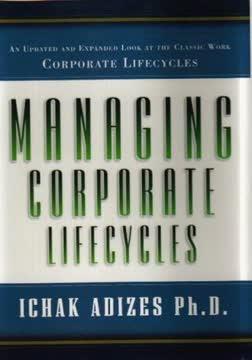
Every organization begins with a dream. Someone, somewhere, imagines something that does not yet exist and decides to bring it into being. That initial spark of commitment, which Adizes calls Courtship, carries within it all the hope and possibility of what might come. Yet most organizations do not fulfill their early promise. They stall, stagnate, or collapse under the weight of their own complexity. Why does this happen so predictably? Ichak Kalderon Adizes has spent more than four decades studying this question. He has worked with corporations, governments, and nonprofits across the globe, observing how organizations are born, how they grow, how they age, and how they die. What he discovered is both sobering and hopeful. Organizations follow predictable patterns of development, much like living organisms. They move through identifiable stages, each with its own character, its own strengths, and its own vulnerabilities. The problems an organization faces at one stage are not random. They are the natural consequences of its current stage of development. The sobering part is that most organizations do not recognize where they are. They treat every problem as a crisis rather than as a signal. They apply yesterday's solutions to today's challenges. They confuse the symptoms of growth with the symptoms of decline. The hopeful part is that organizational aging is not inevitable. Unlike biological organisms, organizations can reverse their decline. They can return to vitality. They can sustain peak performance for extended periods. But doing so requires understanding the lifecycle and acting with intention. The central problem Adizes addresses is the relationship between change and problems. Change is constant. It accelerates. Every change brings with it both opportunities and problems. The pursuit of a problem-free existence is not merely futile; it is counterproductive. Problems are not obstacles to organizational life. They are organizational life itself. The question is not whether you will have problems but whether you will have the right problems,…
Continue reading in the MinuteRead app
Get the complete 30-minute summary of Managing Corporate Lifecycles
Get the complete summary in the appChange is constant, and problems are inevitable. The goal is not to eliminate problems but to have the right problems.
Organizations move through predictable lifecycle stages from Courtship to Death. Each stage has its own normal and abnor
Four roles are essential for organizational health: Producing, Administering, Entrepreneurial, and Integrating.
No single individual can excel at all four roles. Build a complementary team.
The typical path develops capabilities sequentially and painfully. The optimal path develops them simultaneously and smo
Organizational aging is not inevitable. It can be reversed with early detection and appropriate intervention.
"Managing Corporate Lifecycles" is a strong fit if you want practical ideas around business, management, leadership, especially themes like change is constant, and problems are inevitable. the goal is not to eliminate problems but to have the right problems; organizations move through predictable lifecycle stages from courtship to death. each stage has its own normal and abnor. The MinuteRead summary distills these concepts into a focused read, whether you're deciding whether to buy the book or applying its lessons at work.
Ichak Kalderon Adizes is a renowned management expert with over 40 years of experience. He developed a methodology for organizational change management, earning recognition as a top thought leader and consultant. Adizes has received numerous honorary doctorates and awards, including the Ellis Island Medal of Honor. He has taught at prestigious universities and founded the Adizes Institute, a leading consulting firm. Adizes has authored 14 books translated into 24 languages, with "Corporate Lifec…
View all summaries by Ichak Kalderon AdizesContinue Reading
Access the complete 30-minute summary and thousands more nonfiction books in the MinuteRead app.

Continue reading the complete summary in the MinuteRead app.






