 MinuteRead
30 min
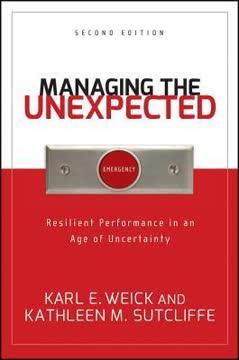
Book summary
Premium summary · Opens in the app · 30 min read
On January 15, 2009, US Airways Flight 1549 struck a flock of Canada geese shortly after takeoff from LaGuardia Airport. Both engines failed. Captain Chesley Sullenberger and First Officer Jeffrey Skiles had roughly three minutes to make decisions that would determine whether 155 people lived or died.
**Author:** Karl E. Weick **Estimated Reading Time:** 42 minutes
Why some organizations navigate crises with remarkable grace while others unravel at the first sign of trouble. You will discover the five principles that distinguish High Reliability Organizations from their more fragile counterparts, how mindfulness operates as a practical organizational capability rather than a vague aspiration, and what it takes to build systems that not only survive disruption but grow stronger because of it.
Leaders who carry responsibility for systems where failure carries real consequences. Managers who sense their organizations have become complacent. Professionals in healthcare, aviation, energy, emergency response, and any field where the unexpected routinely threatens carefully laid plans. Anyone who wants to understand why smart people in well-run organizations still get blindsided, and what can be done about it.
On January 15, 2009, US Airways Flight 1549 struck a flock of Canada geese shortly after takeoff from LaGuardia Airport. Both engines failed. Captain Chesley Sullenberger and First Officer Jeffrey Skiles had roughly three minutes to make decisions that would determine whether 155 people lived or died. What happened next has been celebrated as a miracle. But the people who study organizational reliability see something different. They see an organization, a crew, and a set of practices that had been deliberately prepared for exactly this kind of impossibility. The landing on the Hudson River was not luck. It was the visible outcome of invisible preparation. Karl Weick has spent decades studying organizations that operate under conditions where failure is always possible and often catastrophic. Nuclear power plants. Aircraft carriers. Wildland firefighting crews. Emergency rooms. Air traffic control centers. These are environments where the unexpected is not an occasional inconvenience but a constant companion. The central question of this book is deceptively simple: Why do some organizations handle the unexpected with remarkable effectiveness while others collapse into confusion and blame? The answer, Weick argues, has little to do with better planning, more detailed procedures, or stricter compliance. It has everything to do with how organizations think. Specifically, it has to do with mindfulness. Most organizations operate on autopilot. They develop routines, standardize processes, and create hierarchies precisely so that people do not have to think constantly about what they are doing. This is efficient. It is also dangerous. Because when the unexpected arrives, autopilot thinking is exactly the wrong kind of thinking. Mindful organizations are different. They maintain a state of active, nuanced attention to the present moment. They notice small discrepancies. They question their own assumptions. They resist the comfort of simple explanations. They treat every deviation from expectation as information rather than noise. This book is about how they do it. The research behind these ideas comes from…
Continue reading in the MinuteRead app
Get the complete 30-minute summary of Managing the Unexpected
Get the complete summary in the appMindfulness is the ability to see what is actually happening, especially when it contradicts expectations.
Every major failure begins as a series of small failures that were ignored or rationalized.
Simplification creates blind spots. Preserve complexity to see early warning signs.
Stay connected to operations. The gap between formal and actual is where problems hide.
Prevention is necessary but insufficient. Build resilience to absorb what cannot be prevented.
In crises, expertise matters more than hierarchy. Defer to whoever knows the most.
"Managing the Unexpected" is a strong fit if you want practical ideas around business, leadership, management, especially themes like mindfulness is the ability to see what is actually happening, especially when it contradicts expectations; every major failure begins as a series of small failures that were ignored or rationalized. The MinuteRead summary distills these concepts into a focused read, whether you're deciding whether to buy the book or applying its lessons at work.
Karl E. Weick is a renowned American organizational theorist who has made significant contributions to the field of organizational studies. He introduced key concepts such as "loose coupling," "mindfulness," and "sensemaking," which have had a profound impact on understanding organizational behavior and dynamics. Weick currently holds the distinguished position of Rensis Likert Distinguished University Professor at the University of Michigan's Ross School of Business. His work has been influenti…
View all summaries by Karl E. WeickContinue Reading
Access the complete 30-minute summary and thousands more nonfiction books in the MinuteRead app.

Continue reading the complete summary in the MinuteRead app.






