 MinuteRead
30 min
Book summary
Premium summary · Opens in the app · 30 min read
Most negotiations fail before they begin. Not because the parties lack intelligence or desire, but because they approach impossible situations with ordinary tools. They prepare arguments. They calculate positions. They anticipate concessions. And then they watch the entire process collapse under the weight of mistrust, miscommunication, and missed opportunities.
**Author:** Deepak Malhotra
**Estimated Reading Time:** 45 minutes
**What You'll Learn:** How to negotiate effectively when the stakes are enormous, the parties distrust each other, and the odds of success seem impossibly low. You will learn frameworks for framing, process design, empathy, and strategic thinking that apply to business deals, diplomatic standoffs, and everyday conflicts.
**Who This Book Is For:** Leaders facing high-stakes negotiations, professionals navigating complex organizational dynamics, entrepreneurs closing critical deals, and anyone who has ever felt stuck in a conflict that seemed impossible to resolve.
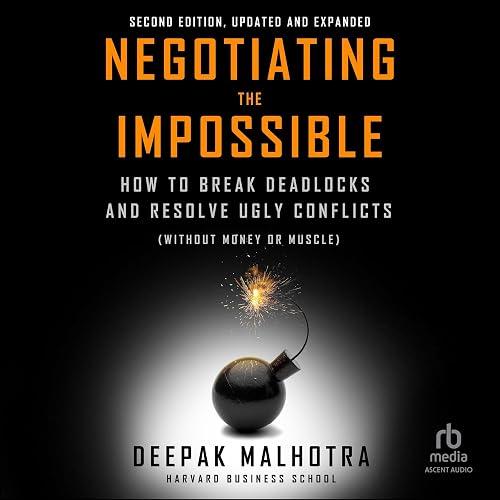
Most negotiations fail before they begin. Not because the parties lack intelligence or desire, but because they approach impossible situations with ordinary tools. They prepare arguments. They calculate positions. They anticipate concessions. And then they watch the entire process collapse under the weight of mistrust, miscommunication, and missed opportunities. Deepak Malhotra wrote *Negotiating the Impossible* to address a specific problem: what do you do when the standard playbook fails? When the other side refuses to engage? When the issues are so emotionally charged that rational discussion seems impossible? When the gap between positions is so vast that no obvious compromise exists? The answer, Malhotra argues, is not to try harder with conventional tactics. The answer is to think differently about what negotiation actually is and what makes it work. Malhotra is uniquely positioned to offer this guidance. As a professor at Harvard Business School, he has spent decades studying negotiation in contexts ranging from corporate boardrooms to international peace talks. He has advised CEOs, government leaders, and diplomats facing seemingly intractable conflicts. What he discovered is that the principles that work in the most extreme cases also work in everyday negotiations. The difference is that extreme cases reveal these principles more clearly because the stakes are so high and the obstacles so visible. The central insight of the book is that negotiation is not primarily about power, leverage, or clever tactics. It is about understanding how people perceive situations, make decisions, and justify their choices to themselves and others. When you understand these deeper dynamics, you can find paths forward that others miss. Consider the challenge facing Abraham Lincoln during the Civil War. He was negotiating not just with the Confederacy but with his own cabinet, Congress, and a divided public. Or consider the negotiations between the NFL and its players' union during the 2011 lockout, where billions of dollars and the future of America's most popular sport hung in the balance. Or think about the negotiations between the United States and Iran over nuclear weapons, where decades of hostility and mutual suspicion made even sitting at the same table seem impossible. In each case, the parties faced what appeared to be…
Continue reading in the MinuteRead app
Get the complete 30-minute summary of Negotiating the Impossible
Get the complete summary in the app**Control the frame.** The frame shapes how everything else is interpreted. Establish your frame early and reinforce it
**Negotiate process before substance.** Agree on how the negotiation will unfold before diving into what will be agreed.
**Preserve forward momentum.** In long-term negotiations, momentum is your most important asset. Protect it even at the
**Use empathy strategically.** Understanding the other side's perspective expands your options. Empathy is not weakness;
**Map the negotiation space.** Identify all relevant parties and understand their interests, constraints, alternatives,
**See others as partners.** The partner mindset makes collaboration possible. It is about approach, not about weakness.
"Negotiating the Impossible" is a strong fit if you want practical ideas around business, psychology, self help, especially themes like **control the frame.** the frame shapes how everything else is interpreted. establish your frame early and reinforce it; **negotiate process before substance.** agree on how the negotiation will unfold before diving into what will be agreed. The MinuteRead summary distills these concepts into a focused read, whether you're deciding whether to buy the book or applying its lessons at work.
Motivated to help readers with the frame that takes hold will shape how negotiators make decisions, Deepak Malhotra wrote “Negotiating the Impossible” to package those ideas for a fast, focused read. In “Negotiating the Impossible”, Deepak Malhotra focuses on the frame that takes hold will shape how negotiators make decisions. Through “Negotiating the Impossible”, Deepak Malhotra distills the core ideas on business into lessons readers can absorb in a single short sitting. Readers turn to this w…
View all summaries by Deepak MalhotraContinue Reading
Access the complete 30-minute summary and thousands more nonfiction books in the MinuteRead app.

Continue reading the complete summary in the MinuteRead app.






