MinuteRead
30 min
Book summary
by Nicole Fenton
Premium summary · Opens in the app · 30 min read
Every day, millions of people struggle to understand the websites and apps they use. They encounter confusing error messages, vague button labels, jargon-filled product descriptions, and marketing copy that talks at them instead of with them. They abandon shopping carts, delete apps, and leave websites not because the product was bad, but because the words got in the way.
**Author:** Nicole Fenton and Kate Kiefer Lee
**Estimated Reading Time:** 45 minutes
**What You'll Learn:** How to write clear, useful, and friendly content for the web. You'll discover how to develop an authentic brand voice, adapt your tone to different situations, create intuitive interface copy, handle sensitive topics with care, and build a revision process that produces consistently excellent writing.
**Who This Book Is For:** Writers, designers, marketers, product managers, customer support professionals, and anyone who creates content for websites, apps, or digital products. Whether you're a solo founder writing your first landing page or a content lead managing a team, this book gives you the principles and practices to communicate with confidence.
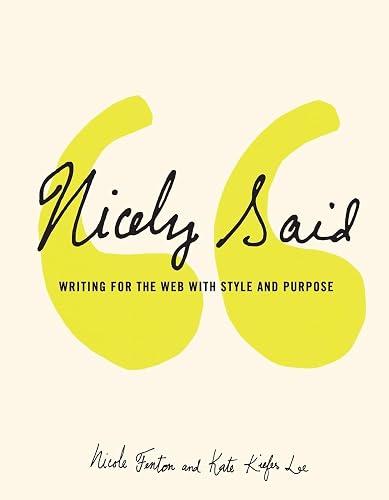
Every day, millions of people struggle to understand the websites and apps they use. They encounter confusing error messages, vague button labels, jargon-filled product descriptions, and marketing copy that talks at them instead of with them. They abandon shopping carts, delete apps, and leave websites not because the product was bad, but because the words got in the way. This is a strange problem when you think about it. The web is made of words. Every page, every interface, every interaction depends on language. Yet most organizations treat writing as an afterthought. They spend months designing interfaces and building features, then scramble to fill in the words at the last minute. They hire designers who obsess over pixels and spacing, but never stop to consider whether the sentence on the screen actually makes sense to the person reading it. The result is a web full of content that sounds like it was written by a committee. Content that uses words like "utilize" when "use" would work better. Content that says "we apologize for the inconvenience" instead of "we're sorry this happened." Content that buries important information under layers of corporate speak and vague promises. Nicole Fenton and Kate Kiefer Lee wrote "Nicely Said" to address this problem. Both authors spent years working as writers and editors in the tech industry, watching the same mistakes happen again and again. They saw brilliant products undermined by confusing copy. They saw companies with great values communicate like faceless corporations. They saw teams struggle to write consistently because no one had ever defined what good writing meant for their organization. The book's central argument is simple but profound: writing is design. The words on your website are not decoration. They are the interface. They guide people through your product, answer their questions, calm their fears, and help them accomplish their goals. When you treat writing as a design discipline, you stop thinking about it as something you do at the end of a project and start thinking about it as something…
Continue reading in the MinuteRead app
Get the complete 30-minute summary of Nicely Said
Get the complete summary in the appGood content is clear, useful, and friendly. Use these three qualities as your guiding principles.
Your voice should reflect your authentic personality, not a fictional persona. Be who you actually are.
Tone adapts to the situation. Consider your reader's emotional state and adjust accordingly.
Use simple language. Choose the short word over the long one. Avoid jargon.
Every piece of content should serve a purpose. If it doesn't help your reader, cut it.
Interface copy is design. Buttons should say what they do. Error messages should tell users how to fix the problem.
"Nicely Said" is a strong fit if you want practical ideas around writing, business, design, especially themes like good content is clear, useful, and friendly. use these three qualities as your guiding principles; your voice should reflect your authentic personality, not a fictional persona. be who you actually are. The MinuteRead summary distills these concepts into a focused read, whether you're deciding whether to buy the book or applying its lessons at work.
Motivated to help readers with "Good content is clear, Nicole Fenton wrote “Nicely Said” to package those ideas for a fast, focused read. In “Nicely Said”, Nicole Fenton focuses on "Good content is clear. Through “Nicely Said”, Nicole Fenton distills the core ideas on writing into lessons readers can absorb in a single short sitting. Readers turn to this work when they want Nicole Fenton's perspective on the subject without working through the entire original volume. Nicole Fenton wrote “Nicely …
Continue Reading
Access the complete 30-minute summary and thousands more nonfiction books in the MinuteRead app.

Continue reading the complete summary in the MinuteRead app.