MinuteRead
5 min
Book summary
Premium summary · Opens in the app · 5 min read
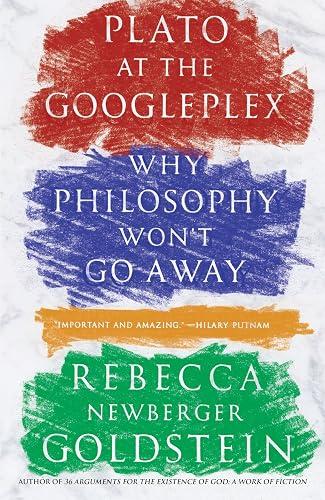
Plato At The Googleplex asks what would happen if ancient philosopher Plato were alive today and came in contact with the modern world, for example by touring Google’s headquarters, and what the implications of his encounters are for the relevance of philosophy in our civilized, hyper-technological world.
Plato At The Googleplex asks what would happen if ancient philosopher Plato were alive today and came in contact with the modern world, for example by touring Google’s headquarters, and what the implications of his encounters are for the relevance of philosophy in our civilized, hyper-technological world.
What’s your gut reaction to not knowing something? Sure, google it. In a 2016 world, we have the entire knowledge of history in our pockets, and while Google is great for fact-checking, recipe-reading and news-updating, it has a tougher time answering some questions for us than others.
For example, what about big questions, which concern morality, ethics, or highly debatable topics, like the death penalty, abortion, genetic crops? There’s no way one person can answer those in single a blog post.
What’s more, Google’s biggest advantage is also one of its greatest weaknesses: the fact that it crowdsources information.
For example, if you want answers about how to feed and take care of your horse, who would you rather go to: one, trained, certified, experienced horse trainer, or a crowd of 200,000 people, all of which know a little bit about horses?
The truth is that the highest ranking answers to questions on Google might be solutions to problems that have worked for a lot of people – but it doesn’t mean they’ll work for all people.
As great as Google’s answers are, there’s one thing you should never forget – to question them, like you’d do with all answers you’d get elsewhere too.
When do you think school stopped being useful for you? For me, I think it happened somewhere around 7th or 8th grade. After learning the rule of three to calculate percentages and being set up with basic English and Latin grammar, I would’ve been a lot better off if someone had given me a pen, told me to write, learn about whatever topic I like and hand me a business book.
In Germany, if you finish high school, you’ll have 12-13 years of conventional education, which for most people means that at some point, they stop actually learning (except for memorizing stuff).
That’s because after laying the groundwork of learning, education needs to adapt to our individual talents, skills and needs.
As Plato put it, by laying words into his character Socrates’s mouth: “Every child is not the same, hence education cannot be the same for every child.”
Sadly, even today few school systems do this, so for now, it means educating yourself – which is what you’re doing right now, right here!
Continue reading in the MinuteRead app
Get the complete 5-minute summary of Plato At The Googleplex
Get the complete summary in the appYou can google your way to answers to a lot of questions, but not all of them.
Education should lay a solid foundation for each of us, but then must adapt to us as individuals.
Love is a pre-requisite for all human relationships – if you define it like Plato does.
"Plato At The Googleplex" is a strong fit if you want practical ideas around creativity, culture, education, especially themes like you can google your way to answers to a lot of questions, but not all of them; education should lay a solid foundation for each of us, but then must adapt to us as individuals. The MinuteRead summary distills these concepts into a focused read, whether you're deciding whether to buy the book or applying its lessons at work.
Rebecca Goldstein is a MacArthur Fellow, a professor of philosophy, and a recipient of the National Medal of the Humanities. She is the author of five novels and a collection of short stories, as well as the author of five books of non-fiction, all on philosophy, from logic to existentialism. She lives in Boston, Massachusetts.
View all summaries by Rebecca GoldsteinContinue Reading
Access the complete 5-minute summary and thousands more nonfiction books in the MinuteRead app.

Continue reading the complete summary in the MinuteRead app.