MinuteRead
30 min
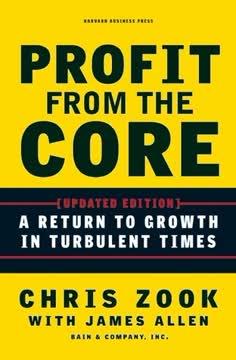
Book summary
by Chris Zook
Premium summary · Opens in the app · 30 min read
Every year, thousands of companies announce ambitious growth plans. They project revenue increases, promise market expansion, and tell shareholders stories of untapped opportunity. Yet the data tells a sobering story. Only a small fraction of these companies actually achieve profitable, sustainable growth over time. The vast majority either stagnate, destroy value through misguided expansion, or find themselves disrupted by competitors they never saw coming.
**Author:** Chris Zook
**Estimated Reading Time:** 42 minutes
**What You'll Learn:**
- Why most growth strategies fail and what separates the rare companies that succeed - How to identify and define your true core business with precision - Why your strongest business likely has far more untapped potential than you realize - How to expand into adjacent markets without destroying value - When industry turbulence demands redefining your core entirely - How to build organizational structures that support rather than inhibit growth
**Who This Book Is For:**
This book is for executives, entrepreneurs, investors, and managers who face the central dilemma of business strategy: how to grow profitably without losing focus. If you have ever wondered whether to double down on what you do best or chase new opportunities, if you have watched competitors expand while your growth stalls, or if you sense that your company is sitting on untapped potential, this book provides the framework you need.
Every year, thousands of companies announce ambitious growth plans. They project revenue increases, promise market expansion, and tell shareholders stories of untapped opportunity. Yet the data tells a sobering story. Only a small fraction of these companies actually achieve profitable, sustainable growth over time. The vast majority either stagnate, destroy value through misguided expansion, or find themselves disrupted by competitors they never saw coming. Chris Zook spent years studying this puzzle. As a partner at Bain & Company leading the Global Strategy Practice, he had access to one of the most comprehensive databases of corporate performance ever assembled. He and his team analyzed thousands of companies across industries and geographies, tracking their strategies, their investments, and their outcomes over decades. What they found challenged much of the conventional wisdom about growth. The central finding was striking: the companies that achieved sustained, profitable growth almost always did so by focusing intensely on a single, well-defined core business. They did not diversify into unrelated industries. They did not chase hot markets. They did not abandon what made them successful in search of novelty. Instead, they found ways to extract far more value from their existing strengths than anyone thought possible. This insight runs counter to the instincts of many executives. When growth slows, the natural impulse is to look elsewhere. The grass seems greener in adjacent markets, new technologies, or entirely different industries. But Zook's research shows that this impulse is usually wrong. The companies that strayed too far from their core typically underperformed. The companies that stayed close to home, but expanded intelligently around their strengths, created the most value. The problem is not that growth is impossible. The problem is that most companies pursue it in the wrong way. They either underinvest…
Continue reading in the MinuteRead app
Get the complete 30-minute summary of Profit from the Core
Get the complete summary in the appFocus on a strong, well-defined core business. Companies with one core business and a leadership position consistently o
Define your core with precision across five dimensions: products, capabilities, customers, channels, and geographies. Mo
Your strongest core business has more untapped potential than you realize. Assess its full potential before seeking grow
Expand into adjacencies that share economics with your core and reinforce your strengths. Avoid unrelated diversificatio
Develop a repeatable formula for adjacency expansion. Systematic growth beats opportunistic bets.
Watch for signs of industry turbulence: low-end erosion, customer defection, new microsegments, and blurring boundaries.
"Profit from the Core" is a strong fit if you want practical ideas around business, management, economics, especially themes like focus on a strong, well-defined core business. companies with one core business and a leadership position consistently o; define your core with precision across five dimensions: products, capabilities, customers, channels, and geographies. mo. The MinuteRead summary distills these concepts into a focused read, whether you're deciding whether to buy the book or applying its lessons at work.
Chris Zook is a prominent business writer and strategy expert. As a partner at Bain & Company, he leads the Global Strategy Practice, bringing extensive experience in corporate strategy to his work. Zook's expertise focuses on helping companies identify and capitalize on their core business strengths to drive growth and profitability. His insights are drawn from years of consulting with major corporations and studying successful business strategies. Zook's writing style combines academic researc…
View all summaries by Chris ZookContinue Reading
Access the complete 30-minute summary and thousands more nonfiction books in the MinuteRead app.

Continue reading the complete summary in the MinuteRead app.