 MinuteRead
30 min
Book summary
by Eric Lamarre
Premium summary · Opens in the app · 30 min read
Most digital transformations fail. The numbers have remained stubbornly consistent for years. Depending on which study you consult, somewhere between 70 and 80 percent of large-scale digital transformation efforts do not achieve their stated objectives. Billions of dollars are spent. Countless hours are invested. And yet, the promised results often fail to materialize.
**Author:** Eric Lamarre, Kate Smaje, and Rodney Zemmel
**Estimated Reading Time:** 45 minutes
**What You'll Learn:** How to build a digitally capable organization that continuously adapts, innovates, and creates value in an era defined by artificial intelligence and rapid technological change.
**Who This Book Is For:** Business leaders, executives, and managers who are responsible for guiding their organizations through digital transformation and want a practical, proven roadmap for doing so successfully.
Most digital transformations fail. The numbers have remained stubbornly consistent for years. Depending on which study you consult, somewhere between 70 and 80 percent of large-scale digital transformation efforts do not achieve their stated objectives. Billions of dollars are spent. Countless hours are invested. And yet, the promised results often fail to materialize. This is not because the technology is too difficult. It is not because the strategy was wrong. It is not because the competition moved faster. The primary reason most digital transformations fail is that organizations treat them as technology projects rather than as fundamental rewiring of how the company operates. The authors of this book spent years studying companies that succeeded where others failed. They worked directly with organizations across industries, helping them navigate the complexities of digital and AI transformation. What they discovered was both sobering and encouraging. The sobering part is that there are no shortcuts. The encouraging part is that success follows a recognizable pattern, one that can be learned and replicated. The problem is that most leaders approach digital transformation with an incomplete mental model. They focus on individual initiatives: a new app here, a data platform there, a pilot AI project somewhere else. These efforts may produce localized wins, but they rarely add up to lasting competitive advantage. The organization remains fundamentally unchanged underneath. What the authors found is that true digital transformation requires rewiring the entire enterprise. It means changing how decisions are made, how teams are organized, how technology is built, how data is used, and how value is delivered. It means building what they call a digital and AI capability that becomes a permanent part of the organization, not a temporary program with a defined end date. This is a profound shift in perspective. Most leaders think of digital transformation as a journey with a destination. You arrive, you celebrate, and you move on to the next challenge. The reality is that business leaders will be digitally transforming their companies for the rest of their careers. The technology will keep changing. Customer expectations will keep rising. Competitors will keep advancing. The organizations that thrive will be those that build the muscle to continuously adapt. The stakes are significant. The authors' research shows that digital leaders in banking delivered…
Continue reading in the MinuteRead app
Get the complete 30-minute summary of Rewired
Get the complete summary in the appDigital transformation is a continuous journey, not a one-time event. You will be doing this for the rest of your career
Build a business-led roadmap that focuses on three to five high-value domains.
You cannot outsource your way to digital excellence. Build internal digital talent.
Being agile requires structural change, not just adopting agile practices.
A decoupled technology architecture enables speed and innovation at scale.
Treat data as a product with clear owners, quality standards, and reusable interfaces.
"Rewired" is a strong fit if you want practical ideas around business, technology, artificial intelligence, especially themes like digital transformation is a continuous journey, not a one-time event. you will be doing this for the rest of your career; build a business-led roadmap that focuses on three to five high-value domains. The MinuteRead summary distills these concepts into a focused read, whether you're deciding whether to buy the book or applying its lessons at work.
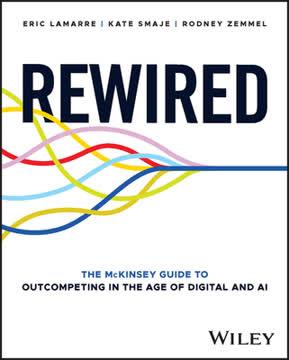
Eric Lamarre, Kate Smaje, and Rodney Zemmel are the authors of "Rewired: The McKinsey Guide to Outcompeting in the Age of Digital and AI." They are consultants at McKinsey & Company, a global management consulting firm. The authors leverage McKinsey's extensive research and expertise to provide strategic insights on digital transformation and AI implementation for businesses. Their work focuses on helping organizations adapt to technological changes, build digital capabilities, and maintain comp…
View all summaries by Eric LamarreContinue Reading
Access the complete 30-minute summary and thousands more nonfiction books in the MinuteRead app.

Continue reading the complete summary in the MinuteRead app.






