 MinuteRead
30 min
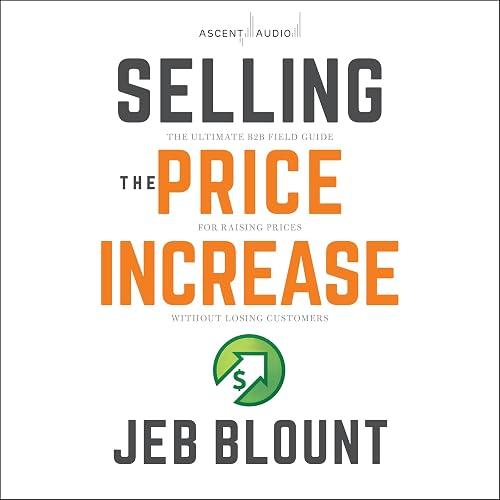
Book summary
by Jeb Blount
Premium summary · Opens in the app · 30 min read
Every year, companies leave billions of dollars on the table because their salespeople are afraid to ask for more money.
**Author:** Jeb Blount
**Estimated Reading Time:** 45 minutes
**What You'll Learn:**
- Why fear, not strategy, is the real obstacle to raising prices - The five-step process for conducting price increase conversations - Eight proven narratives that make price increases acceptable - How to handle objections without losing your nerve or the account - A negotiation framework that protects your margins - Leadership strategies for rolling out price increases across a team
**Who This Book Is For:**
Sales professionals who dread telling customers prices are going up. Account managers who worry about damaging relationships. Business owners who need to raise prices but keep putting it off. Sales leaders responsible for implementing company-wide price increases. Anyone who has ever lost sleep over a difficult conversation about money.
Every year, companies leave billions of dollars on the table because their salespeople are afraid to ask for more money. The strange thing is that most salespeople know exactly what to say. They understand the logic of price increases. They can explain why costs have risen, why their product is worth more, and why the customer should accept the new pricing. They have rehearsed the conversation in their heads dozens of times. But when the moment comes, something happens. The heart rate spikes. The palms sweat. The mind goes blank. And instead of confidently delivering the news, the salesperson hedges, apologizes, or worse, avoids the conversation entirely. They offer discounts. They make exceptions. They quietly absorb the cost increase themselves rather than risk the discomfort of asking a customer to pay more. This is not a knowledge problem. It is an emotional problem. Jeb Blount has spent decades studying sales performance, and his central insight in this book is both simple and profound: in every price increase conversation, the person who exerts the greatest emotional control has the highest probability of achieving their desired outcome. The customer who stays calm and pushes back will beat the salesperson who panics. The salesperson who remains composed and confident will win over the customer who reacts emotionally. The outcome is determined less by the facts of the situation and more by who can manage their emotions under pressure. This matters because price increases are not optional for most businesses. Costs rise. Labor gets more expensive. Materials fluctuate. If you cannot pass some of these increases along to customers, your margins shrink, your profitability suffers, and eventually your business becomes unsustainable. Yet many companies treat price increases as a last resort, something to be delayed and minimized, because they are terrified of customer backlash. The irony is that most customers accept price increases without much resistance. They may grumble. They may push back. They may ask for concessions.…
Continue reading in the MinuteRead app
Get the complete 30-minute summary of Selling the Price Increase
Get the complete summary in the app**Emotional control wins.** The person who stays calm has the advantage in any price increase conversation.
**Fear is biological, not personal.** Your brain treats rejection as a threat. That does not mean the threat is real.
**Build relationships before you need them.** Strong relationships make price increases easier.
**Follow a process.** The five-step process reduces uncertainty and increases consistency.
**Choose the right narrative.** Different customers respond to different messages. Tailor your approach.
**State the increase as a fact, then be silent.** The assumptive close signals confidence.
"Selling the Price Increase" is a strong fit if you want practical ideas around business, marketing, management, especially themes like **emotional control wins.** the person who stays calm has the advantage in any price increase conversation; **fear is biological, not personal.** your brain treats rejection as a threat. that does not mean the threat is real. The MinuteRead summary distills these concepts into a focused read, whether you're deciding whether to buy the book or applying its lessons at work.
Motivated to help readers with in every price increase conversation, Jeb Blount wrote “Selling the Price Increase” to package those ideas for a fast, focused read. In “Selling the Price Increase”, Jeb Blount focuses on in every price increase conversation. Through “Selling the Price Increase”, Jeb Blount distills the core ideas on business into lessons readers can absorb in a single short sitting. Readers turn to this work when they want Jeb Blount's perspective on the subject without working th…
View all summaries by Jeb BlountContinue Reading
Access the complete 30-minute summary and thousands more nonfiction books in the MinuteRead app.

Continue reading the complete summary in the MinuteRead app.






