 MinuteRead
30 min
Book summary
by Jeanne Liedtka
Premium summary · Opens in the app · 30 min read
Most organizations are very good at analyzing problems and very bad at solving them in new ways. They have refined the art of spreadsheet logic, risk assessment, and stage-gate approval processes. Yet when faced with a challenge that does not fit existing categories, many teams default to the same tired approaches: more data collection, more internal debate, more incremental tweaks to existing offerings.
**Author:** Jeanne Liedtka
**Estimated Reading Time:** 45 minutes
**What You'll Learn**
How to apply a systematic, human-centered approach to innovation that transforms vague challenges into concrete solutions. You will discover the four-stage design thinking process, learn the tools that make ideas tangible, and understand how to bring this discipline into your organization in a way that sticks.
**Who This Book Is For**
Managers who need better answers than incremental improvement. Team leaders who want to break down silos and unlock creative collaboration. Entrepreneurs seeking a reliable method for understanding customers deeply. And anyone who suspects that the way we solve problems today is not equal to the complexity of the problems we face.
Most organizations are very good at analyzing problems and very bad at solving them in new ways. They have refined the art of spreadsheet logic, risk assessment, and stage-gate approval processes. Yet when faced with a challenge that does not fit existing categories, many teams default to the same tired approaches: more data collection, more internal debate, more incremental tweaks to existing offerings. The result is predictable. Products that customers do not love. Services that frustrate the people who use them. Internal processes that everyone complains about but no one changes. And a quiet sense inside organizations that the real opportunities are slipping away. Jeanne Liedtka wrote this book to address a specific problem: the gap between the way organizations think they innovate and the way innovation actually happens. She spent years studying managers, designers, and teams across industries. What she found is that most organizations do not lack creativity. They lack a disciplined process for turning creativity into something real, testable, and valuable. Design thinking provides that discipline. The term itself can be misleading. It sounds like something reserved for people who sketch products or choose color palettes. But Liedtka's research shows something different. Design thinking is a problem-solving methodology that any team can learn. It is systematic without being rigid. It is creative without being chaotic. It is human-centered without being soft. The book's central insight is that innovation is not a mysterious gift possessed by a few brilliant individuals. It is a process that can be learned, practiced, and scaled. The organizations that succeed at innovation are not necessarily the ones with the most creative people. They are the ones with the best process for discovering what matters, generating options, testing assumptions, and learning quickly. Liedtka and her colleagues spent years embedded with organizations attempting to use design thinking. They watched teams struggle. They documented what worked and what failed. They identified the specific tools, mindsets, and leadership behaviors that separate successful innovation efforts from expensive disappointments. What emerged is a practical framework built…
Continue reading in the MinuteRead app
Get the complete 30-minute summary of Solving Problems with Design Thinking
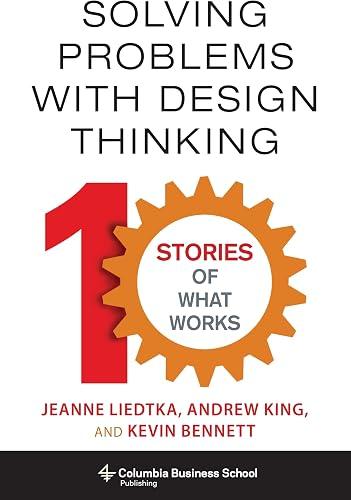
Get the complete summary in the appDesign thinking is a structured process built around four questions: What is? What if? What wows? What works?
Start with empathy. Understand the people you are designing for before you try to solve anything.
Observation reveals what people actually do, not what they say they do.
Generate many options before you converge on a solution. Divergence prevents premature closure.
Make ideas visible through sketches, storyboards, and prototypes. Concrete ideas get better feedback.
Use low-fidelity prototypes. Rough prototypes invite honest feedback and accelerate learning.
"Solving Problems with Design Thinking" is a strong fit if you want practical ideas around business, design, management, especially themes like design thinking is a structured process built around four questions: what is? what if? what wows? what works?; start with empathy. understand the people you are designing for before you try to solve anything. The MinuteRead summary distills these concepts into a focused read, whether you're deciding whether to buy the book or applying its lessons at work.
Motivated to help readers with design thinking offers a great start to bridge building, Jeanne Liedtka wrote “Solving Problems with Design Thinking” to package those ideas for a fast, focused read. In “Solving Problems with Design Thinking”, Jeanne Liedtka focuses on design thinking offers a great start to bridge building. Through “Solving Problems with Design Thinking”, Jeanne Liedtka distills the core ideas on business into lessons readers can absorb in a single short sitting. Readers turn to …
Continue Reading
Access the complete 30-minute summary and thousands more nonfiction books in the MinuteRead app.

Continue reading the complete summary in the MinuteRead app.






