MinuteRead
30 min
Book summary
by Masaaki Imai
Premium summary · Opens in the app · 30 min read
Most companies that attempt lean transformation fail. They fail quietly, without dramatic collapses or public scandals. They simply drift back to their old ways of working, their old habits of overproduction, their old patterns of firefighting and expediting. The tools they learned in workshops gather dust. The metrics they posted on bulletin boards fade into the background. Within a year, the transformation is remembered as another initiative that came and went.
**Author:** Masaaki Imai **Estimated Reading Time:** 45 minutes
**What You'll Learn:** - Why flow, synchronization, and leveling form the foundation of strategic lean operations - How to shift from forecast-driven overproduction to customer-aligned production - The critical role of leadership in sustaining lean transformation - Practical methods for building a culture of continuous improvement - How to assess and audit your company's lean status using FSL criteria
**Who This Book Is For:** This book is for executives, operations leaders, plant managers, and anyone responsible for organizational transformation. It is written for those who recognize that lean is not a toolkit but a strategic imperative, and who are willing to challenge deeply held assumptions about how work should be organized. If you have tried lean initiatives that failed to stick, or if you are preparing to begin a serious transformation, this book will provide the strategic framework you need.
Most companies that attempt lean transformation fail. They fail quietly, without dramatic collapses or public scandals. They simply drift back to their old ways of working, their old habits of overproduction, their old patterns of firefighting and expediting. The tools they learned in workshops gather dust. The metrics they posted on bulletin boards fade into the background. Within a year, the transformation is remembered as another initiative that came and went. Why does this happen so consistently? Masaaki Imai, the pioneer who introduced kaizen to the world, argues that the answer lies in a fundamental misunderstanding of what lean actually is. Companies treat lean as a collection of techniques: 5S, kanban, value stream mapping, andon systems. They implement the tools without changing the strategic logic that governs the organization. The tools work for a while, then the old logic reasserts itself, and the tools are abandoned. Imai's insight is that lean is not a toolkit. It is a strategic framework built on three interconnected pillars: flow, synchronization, and leveling. Together, these form what he calls FSL, the essential criteria for assessing whether a company is truly lean. Without flow, there is no lean. Without synchronization, flow breaks down. Without leveling, synchronization becomes impossible. These three elements are not optional enhancements. They are the foundation upon which everything else rests. The problem is that traditional companies operate according to an entirely different logic. They maximize resource utilization, produce in large batches, build inventory buffers, and push products through the system based on forecasts. This logic feels safe. It feels efficient. It feels like what a well-managed company should do. But Imai demonstrates that this traditional approach is fundamentally flawed. It creates waste, hides problems, lengthens lead times, and ultimately destroys value. The alternative is a customer-first orientation. Imai makes a bold claim: the…
Continue reading in the MinuteRead app
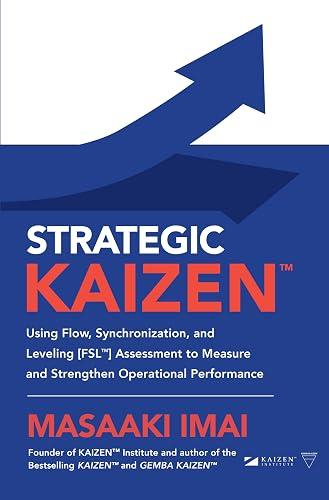
Get the complete 30-minute summary of Strategic Kaizen
Get the complete summary in the appFlow, synchronization, and leveling (FSL) are the must-have criteria for assessing lean status.
Overproduction is the root of all evil in manufacturing.
The ultimate objective of a company is solely to realize customer satisfaction.
Lean transformation requires committed, visible, persistent leadership from the CEO and board.
Go to the gemba when problems arise.
Kaizen is continuous improvement involving everyone in the organization.
"Strategic Kaizen" is a strong fit if you want practical ideas around business, management, leadership, especially themes like flow, synchronization, and leveling (fsl) are the must-have criteria for assessing lean status; overproduction is the root of all evil in manufacturing. The MinuteRead summary distills these concepts into a focused read, whether you're deciding whether to buy the book or applying its lessons at work.
Motivated to help readers with "FSL encompasses the must-have criteria proposed to assess and audit the lean status of a company." Flow is, Masaaki Imai wrote “Strategic Kaizen” to package those ideas for a fast, focused read. In “Strategic Kaizen”, Masaaki Imai focuses on "FSL encompasses the must-have criteria proposed to assess and audit the lean status of a company." Flow is. Through “Strategic Kaizen”, Masaaki Imai distills the core ideas on business into lessons readers can absorb in a sin…
View all summaries by Masaaki ImaiContinue Reading
Access the complete 30-minute summary and thousands more nonfiction books in the MinuteRead app.

Continue reading the complete summary in the MinuteRead app.