MinuteRead
30 min
Book summary
Premium summary · Opens in the app · 30 min read
Every day, leaders of public and nonprofit organizations face a daunting reality. The problems they are asked to solve are growing more complex. The resources available to address them are shrinking or shifting unpredictably. The expectations of stakeholders are rising. And the consequences of failure are measured not in lost profits but in diminished lives, damaged communities, and eroded public trust.
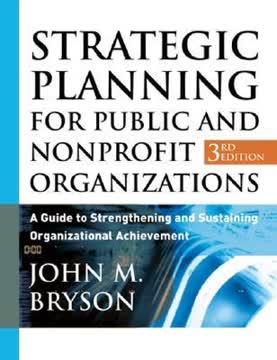
**Author:** John M. Bryson
**Estimated Reading Time:** 45 minutes
**What You'll Learn:**
- Why strategic planning is essential for public and nonprofit organizations navigating complex environments - The complete Strategy Change Cycle, a ten-step framework for effective planning - How to identify mandates, clarify mission, and assess internal and external environments - How to formulate strategies that create lasting public value - How to implement plans successfully and build capacity for ongoing strategic management
**Who This Book Is For:**
Leaders, managers, board members, and staff of public agencies, nonprofit organizations, and community collaborations who want to move beyond reactive decision-making and build organizations capable of creating meaningful, lasting change.
Every day, leaders of public and nonprofit organizations face a daunting reality. The problems they are asked to solve are growing more complex. The resources available to address them are shrinking or shifting unpredictably. The expectations of stakeholders are rising. And the consequences of failure are measured not in lost profits but in diminished lives, damaged communities, and eroded public trust. Consider the executive director of a community health clinic. She must navigate changing federal regulations, shifting demographics in her service area, competition for limited grant funding, evolving medical technologies, and the competing demands of patients, staff, funders, and regulators. Each day brings new challenges that require immediate attention. It is easy to become consumed by the urgent at the expense of the important. This is the problem John M. Bryson addresses in his foundational work on strategic planning for public and nonprofit organizations. The book exists because too many organizations in the public and nonprofit sectors operate without a clear sense of direction. They react to events rather than shaping them. They drift from crisis to crisis, never quite sure whether their efforts are adding up to something meaningful. They work hard but struggle to demonstrate that their work is making a difference. The challenge is not a lack of dedication. People who work in public and nonprofit organizations are often deeply committed to their missions. The challenge is a lack of strategic thinking, acting, and learning. Without a structured approach to understanding their environment, clarifying their purpose, identifying the critical issues they face, and developing coherent responses, even the most dedicated organizations can find themselves spinning their wheels. Bryson's approach is different because it recognizes the unique realities of public and nonprofit organizations. These organizations do not exist to maximize shareholder value. They exist to create public value, to improve the lives of individuals and communities, to address problems that markets and governments alone cannot solve. This means they must answer to multiple stakeholders with often conflicting expectations. They must operate within complex webs of mandates and regulations. They…
Continue reading in the MinuteRead app
Get the complete 30-minute summary of Strategic Planning for Public and Nonprofit Organizations
Get the complete summary in the appStrategic planning helps organizations think, learn, and act strategically in complex environments.
The Strategy Change Cycle provides a flexible ten-step framework for strategic planning.
Clarify mandates and mission before developing strategies.
Assess the environment using SWOC/T analysis to understand strengths, weaknesses, opportunities, and challenges.
Identify a manageable number of strategic issues framed as questions that invite creative thinking.
Formulate strategies that bridge the current state with the desired future and consider implementation feasibility.
"Strategic Planning for Public and Nonprofit Organizations" is a strong fit if you want practical ideas around business, management, textbooks, especially themes like strategic planning helps organizations think, learn, and act strategically in complex environments; the strategy change cycle provides a flexible ten-step framework for strategic planning. The MinuteRead summary distills these concepts into a focused read, whether you're deciding whether to buy the book or applying its lessons at work.
John M. Bryson is a distinguished academic in the field of public affairs and planning. As the McKnight Presidential Professor of Planning and Public Affairs at the Hubert H. Humphrey School of Public Affairs, University of Minnesota, Bryson has established himself as a leading authority on strategic planning for public and nonprofit organizations. His work focuses on helping organizations effectively navigate complex environments and achieve their goals. Bryson's expertise in this area is refle…
View all summaries by John M. BrysonContinue Reading
Access the complete 30-minute summary and thousands more nonfiction books in the MinuteRead app.

Continue reading the complete summary in the MinuteRead app.