 MinuteRead
30 min
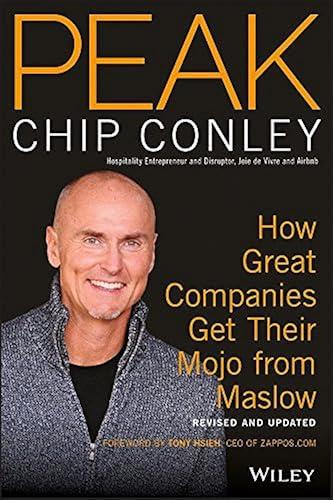
Book summary
by Chip Conley
Premium summary · Opens in the app · 30 min read
Chip Conley was twenty-six years old when he founded Joie de Vivre Hospitality with a single motel in San Francisco's Tenderloin district. He had no formal business training, no MBA, and no experience running a company. What he did have was a degree in psychology and a hunch that the principles he had studied in college might apply to the world of commerce.
By Chip Conley
**Estimated Reading Time:** 45 minutes
**What You'll Learn:** How to apply Abraham Maslow's hierarchy of needs to transform employees, customers, and investors. You'll discover why money alone never creates lasting motivation, how to build customer loyalty that goes beyond satisfaction, and what it takes to create a workplace where people find genuine meaning.
**Who This Book Is For:** Leaders who sense that something is missing in their organization despite decent numbers. Entrepreneurs building companies from scratch. Managers frustrated by high turnover or disengaged teams. Anyone who suspects that business success requires more than spreadsheets and strategy.
Chip Conley was twenty-six years old when he founded Joie de Vivre Hospitality with a single motel in San Francisco's Tenderloin district. He had no formal business training, no MBA, and no experience running a company. What he did have was a degree in psychology and a hunch that the principles he had studied in college might apply to the world of commerce. That hunch turned into a twenty-four-year experiment. By the time Conley stepped down as CEO, Joie de Vivre had become the second-largest boutique hotel company in America, with over fifty properties and a reputation for extraordinary workplace culture. The company survived two major economic downturns, including the dot-com crash that devastated San Francisco's hospitality industry. It thrived while competitors struggled. And Conley credits much of that resilience to an unlikely source: a mid-century psychologist who never ran a business in his life. Abraham Maslow is famous for his hierarchy of needs, a pyramid that describes human motivation from basic survival to self-actualization. Most people encounter the model in a psychology class and never think about it again. Conley saw something different. He saw a framework that could explain why employees disengage, why customers defect, and why investors lose confidence. More importantly, he saw a framework that could help leaders build organizations that truly work. The problem with most businesses, Conley argues, is that they focus almost exclusively on the bottom of the pyramid. They pay employees enough to survive, meet customers' basic expectations, and provide investors with acceptable returns. Then they wonder why nobody seems truly committed. They wonder why their best people leave for competitors, why customers switch the moment a cheaper option appears, and why investors treat their stock as a commodity to be traded rather than a company to be owned with pride. The answer is that human beings are never satisfied by the bottom of the pyramid alone. Once survival needs are met, people naturally seek recognition, belonging, and meaning. When organizations fail to address these higher needs, they leave their most powerful motivational tools on the table. They create transactional relationships when they…
Continue reading in the MinuteRead app
Get the complete 30-minute summary of Peak
Get the complete summary in the appMaslow's hierarchy of needs applies to business relationships. Employees, customers, and investors each have a pyramid w
The employee pyramid is money, recognition, meaning. Money is necessary but not sufficient. Recognition is a gift. Meani
The customer pyramid is satisfaction, commitment, evangelism. Satisfaction is the base, not the goal. Evangelism happens
The investor pyramid is trust, confidence, pride of ownership. The scarce commodity is not a good deal but a good partne
You cannot skip levels. The base of each pyramid must be solid before higher levels become motivating.
Culture is about performance, not conformance. It is a competitive advantage that cannot be copied and a survival mechan
"Peak" is a strong fit if you want practical ideas around business, management, leadership, especially themes like maslow's hierarchy of needs applies to business relationships. employees, customers, and investors each have a pyramid w; the employee pyramid is money, recognition, meaning. money is necessary but not sufficient. recognition is a gift. meani. The MinuteRead summary distills these concepts into a focused read, whether you're deciding whether to buy the book or applying its lessons at work.
Motivated to help readers with "Just like human beings cannot survive by spending all of their time on self-actualization without attending, Chip Conley wrote “Peak” to package those ideas for a fast, focused read. In “Peak”, Chip Conley focuses on "Just like human beings cannot survive by spending all of their time on self-actualization without attending. Through “Peak”, Chip Conley distills the core ideas on business into lessons readers can absorb in a single short sitting. Readers turn to th…
View all summaries by Chip ConleyContinue Reading
Access the complete 30-minute summary and thousands more nonfiction books in the MinuteRead app.

Continue reading the complete summary in the MinuteRead app.






