 MinuteRead
30 min
Book summary
by David Brown
Premium summary · Opens in the app · 30 min read
Business is often presented as a rational discipline governed by spreadsheets, strategic frameworks, and careful analysis. The reality is messier. The most consequential business decisions happen in conditions of uncertainty, where the data is incomplete, the stakes are enormous, and the clock is ticking. In these moments, the leaders who prevail are not necessarily the smartest or the best educated. They are the ones who trust their instincts, act decisively, and refuse to accept failure as a f
**Author:** David Brown
**Estimated Reading Time:** 45 minutes
**What You'll Learn:**
- Why intuition and decisive action matter more than perfect information - How failure functions as a necessary step toward lasting success - What separates companies that thrive during crises from those that collapse - Why relentless adaptation is the only sustainable competitive advantage - How to identify and exploit vulnerabilities in established competitors
**Who This Book Is For:**
This condensed edition is for anyone who wants to understand the brutal, unpredictable, and deeply human nature of business competition. Entrepreneurs, managers, investors, and curious readers will find hard-won lessons drawn from real battles between real companies. If you want to understand why some businesses win and others vanish, this book will show you the patterns behind the outcomes.
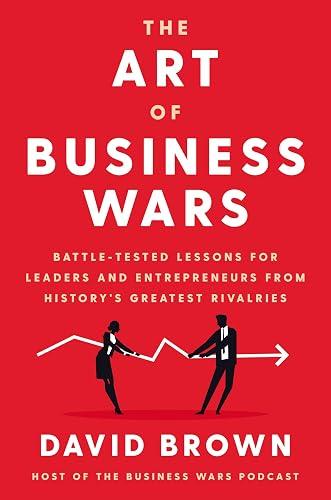
Business is often presented as a rational discipline governed by spreadsheets, strategic frameworks, and careful analysis. The reality is messier. The most consequential business decisions happen in conditions of uncertainty, where the data is incomplete, the stakes are enormous, and the clock is ticking. In these moments, the leaders who prevail are not necessarily the smartest or the best educated. They are the ones who trust their instincts, act decisively, and refuse to accept failure as a final answer. David Brown wrote this book to explore what actually happens when businesses go to war. Drawing from the stories behind some of the most famous corporate rivalries in history, he shows that business competition resembles warfare more than it resembles accounting. There are battles for territory, campaigns of deception, strategic retreats, and moments of extraordinary courage. There are also casualties, sometimes entire companies destroyed by a single miscalculation or a failure to adapt. The problem this book addresses is simple but profound. Most people misunderstand why businesses succeed or fail. They attribute outcomes to luck, timing, or genius, when the real drivers are often more accessible. The leaders profiled in these pages succeeded because they developed deep instincts through years of hands-on experience, because they embraced failure as a learning tool, and because they possessed a determination that bordered on obsession. These are not magical qualities. They are patterns of thinking and behaving that can be understood and applied. This matters because the business landscape is more competitive than ever. The barriers to entry in many industries have collapsed. New competitors can emerge from anywhere. Established players can be disrupted overnight. In this environment, understanding the principles of business warfare is not optional. It is essential for survival. What makes Brown's approach different is his focus on narrative. Rather than presenting abstract theories, he tells stories. The story of how WD-40 got its name after thirty-nine failed formulations. The story of how…
Continue reading in the MinuteRead app
Get the complete 30-minute summary of The Art of Business Wars
Get the complete summary in the appTrust your intuition in areas where you have deep experience. It is the product of pattern recognition, not magic.
Failure is not the opposite of success. It is a step on the path to success. Learn from every failure and keep going.
Determination often matters more than intelligence or resources. The leaders who win are those who refuse to give up.
No victory is final. The moment you become complacent, you become vulnerable. Keep innovating even when you are winning.
Crisis reveals true leaders. Strong companies thrive during downturns while weak companies collapse. See opportunity in
Most initial ideas are wrong. The ability to pivot based on market feedback is often more important than having the perf
"The Art of Business Wars" is a strong fit if you want practical ideas around business, entrepreneurship, leadership, especially themes like trust your intuition in areas where you have deep experience. it is the product of pattern recognition, not magic; failure is not the opposite of success. it is a step on the path to success. learn from every failure and keep going. The MinuteRead summary distills these concepts into a focused read, whether you're deciding whether to buy the book or applying its lessons at work.
Motivated to help readers with 1) Great leaders trust their intuition and act decisively in uncertain situations 2) Resilient businesses, David Brown wrote “The Art of Business Wars” to package those ideas for a fast, focused read. In “The Art of Business Wars”, David Brown focuses on 1) Great leaders trust their intuition and act decisively in uncertain situations 2) Resilient businesses. Through “The Art of Business Wars”, David Brown distills the core ideas on business into lessons readers ca…
Continue Reading
Access the complete 30-minute summary and thousands more nonfiction books in the MinuteRead app.

Continue reading the complete summary in the MinuteRead app.






