 MinuteRead
30 min
Book summary
by Michael A. Roberto
Premium summary · Opens in the app · 30 min read
On January 28, 1986, the space shuttle Challenger broke apart seventy-three seconds after launch. Seven astronauts died. The subsequent investigation revealed that engineers had expressed serious concerns about the O-ring seals in the solid rocket boosters the night before the launch. Those concerns never reached the right people in a way that mattered. The decision to launch proceeded despite clear warning signs.
**Author:** Michael A. Roberto
**Estimated Reading Time:** 45 minutes
**What You'll Learn:**
- Why smart people and strong teams make catastrophic decisions - How to design decision processes that surface hidden risks - The difference between problem solving and problem finding - How to build constructive conflict without destructive politics - What high-reliability organizations do differently - How to balance analysis with decisive action
**Who This Book Is For:**
Leaders, managers, and professionals who want to improve the quality of their decisions. It is for anyone who has watched a seemingly sound plan collapse, wondered how a talented team missed obvious warning signs, or struggled to get honest input from colleagues. If you make decisions that affect other people, this book will change how you think about that responsibility.
On January 28, 1986, the space shuttle Challenger broke apart seventy-three seconds after launch. Seven astronauts died. The subsequent investigation revealed that engineers had expressed serious concerns about the O-ring seals in the solid rocket boosters the night before the launch. Those concerns never reached the right people in a way that mattered. The decision to launch proceeded despite clear warning signs. The Challenger disaster was not caused by a lack of intelligence. The people involved were brilliant engineers and experienced managers. It was not caused by a lack of information. The critical data existed within the organization. The failure was in the decision process itself. The way information flowed, the way dissent was handled, the way pressure shaped judgment, all of it contributed to a catastrophic outcome. This pattern repeats across industries and eras. The Bay of Pigs invasion failed despite the involvement of some of the most accomplished minds in the Kennedy administration. The subprime mortgage crisis unfolded despite warnings from analysts and economists. Corporate giants like Kodak and Blockbuster collapsed despite having access to the very information that predicted their obsolescence. Michael Roberto's work addresses a fundamental question: Why do smart people and capable organizations make such poor decisions? The answer is uncomfortable. We tend to believe that decision quality depends on the intelligence of the decision maker. We assume that if we gather enough data and analyze it carefully, we will arrive at the right answer. We trust that experienced leaders will recognize the right path when they see it. Roberto argues that this view is dangerously incomplete. Decision making is not primarily an individual cognitive act. It is a social and organizational process. The quality of a decision depends less on the brilliance of any single person and more on the design of the process that produces it. Consider how most important decisions actually get made. A leader forms an initial view, often quickly and intuitively.…
Continue reading in the MinuteRead app
Get the complete 30-minute summary of The Art of Critical Decision Making
Get the complete summary in the app**Process over outcome.** Evaluate decisions by how they were made, not just how they turned out.
**Seek disconfirming evidence.** Actively look for information that contradicts your beliefs.
**Beware the sunk-cost trap.** Past investments should not influence future decisions.
**Design for dissent.** Create processes that surface disagreement and challenge assumptions.
**Ask better questions.** The right question is more valuable than the right answer.
**Balance intuition and analysis.** Use intuition to generate hypotheses and analysis to test them.
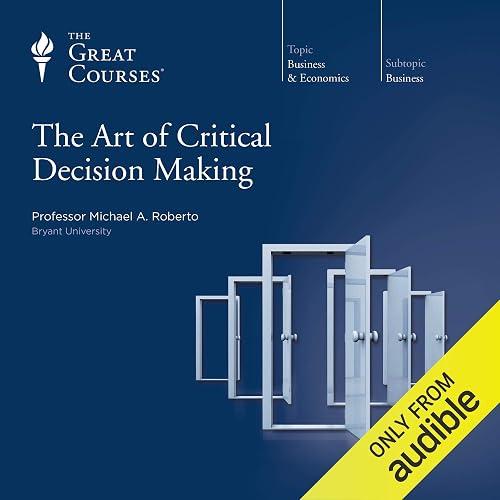
"The Art of Critical Decision Making" is a strong fit if you want practical ideas around business, leadership, management, especially themes like **process over outcome.** evaluate decisions by how they were made, not just how they turned out; **seek disconfirming evidence.** actively look for information that contradicts your beliefs. The MinuteRead summary distills these concepts into a focused read, whether you're deciding whether to buy the book or applying its lessons at work.
Motivated to help readers with 1) Decision-making is a complex process influenced by cognitive biases and organizational dynamics 2), Michael A. Roberto wrote “The Art of Critical Decision Making” to package those ideas for a fast, focused read. In “The Art of Critical Decision Making”, Michael A. Roberto focuses on 1) Decision-making is a complex process influenced by cognitive biases and organizational dynamics 2). Through “The Art of Critical Decision Making”, Michael A. Roberto distills the …
Continue Reading
Access the complete 30-minute summary and thousands more nonfiction books in the MinuteRead app.

Continue reading the complete summary in the MinuteRead app.






