 MinuteRead
30 min
Book summary
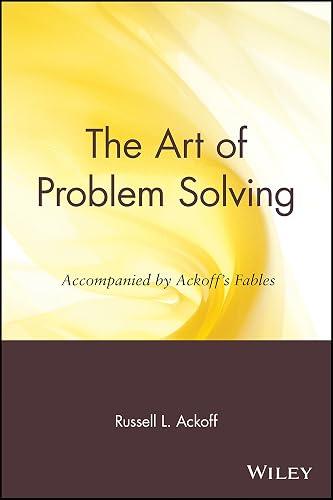
by Russell L. Ackoff
Premium summary · Opens in the app · 30 min read
Most people believe they are better problem solvers than they actually are. They confuse activity with progress, effort with effectiveness, and experience with expertise. They attack symptoms while ignoring causes. They optimize parts while degrading wholes. They solve yesterday's problems with yesterday's thinking and wonder why tomorrow never arrives.
**Author:** Russell L. Ackoff **Estimated Reading Time:** 45 minutes
**What You'll Learn:** - Why creativity is not a gift but a skill that can be developed - How self-imposed constraints silently limit your thinking - The power of idealized design to transform organizations - Why understanding others' objectives resolves conflicts faster than compromise - How to turn uncontrollable variables into manageable ones - The difference between correlation and causation in decision-making - New organizational structures that unlock flexibility and accountability - How to apply experimental thinking to everyday problems
**Who This Book Is For:** Managers, executives, entrepreneurs, and anyone who faces complex problems and wants to move beyond incremental improvements toward breakthrough solutions.
Most people believe they are better problem solvers than they actually are. They confuse activity with progress, effort with effectiveness, and experience with expertise. They attack symptoms while ignoring causes. They optimize parts while degrading wholes. They solve yesterday's problems with yesterday's thinking and wonder why tomorrow never arrives. Russell Ackoff spent his career watching smart people make these mistakes. As a pioneer in operations research and systems thinking, he consulted with hundreds of organizations across government, industry, and education. Time after time, he observed the same pattern: well-intentioned managers applying rigorous analysis to the wrong problems, or applying the right analysis but missing the creative leap that would have made the solution elegant instead of merely adequate. Ackoff believed the problem was not intelligence. His clients were brilliant. The problem was imagination, or more precisely, the systematic suppression of imagination that occurs as people become experts. Education teaches us what is known. Experience teaches us what has worked. Both quietly teach us what is impossible. By the time most professionals reach positions of authority, they have accumulated a vast collection of invisible constraints, assumptions about what cannot be done, what must be done, and how things are supposed to work. These constraints are not real. They are artifacts of habit, culture, and training. And because they are invisible, they operate without being questioned. The result is that most organizations solve problems by making small adjustments to existing systems, never realizing that the system itself is the problem. Ackoff's approach was different. He argued that the greatest skill in problem solving is creativity, and that creativity is not a mysterious gift bestowed on a lucky few. It is a discipline that can be learned, practiced, and improved. The key is learning to identify and remove the constraints you have unconsciously imposed on your own thinking. This book is a distillation of that philosophy. It draws on Ackoff's decades of work with corporations, governments, and universities to present a coherent approach to solving problems creatively and effectively. The…
Continue reading in the MinuteRead app
Get the complete 30-minute summary of The Art of Problem Solving
Get the complete summary in the appCreativity is a learnable skill, not a fixed trait. Practice questioning assumptions and seeking diverse perspectives.
Most problems are puzzles created by self-imposed constraints. Identify and remove the constraints, and the solution bec
Idealized design reveals possibilities that incremental thinking cannot see. Imagine the best possible system, then work
Conflicts are usually conflicts of perception, not conflicts of objectives. Understand what others really want before se
Many uncontrollable variables are actually controllable if you expand the boundaries of the system.
Correlation is not causation. Test causal relationships before acting on them.
"The Art of Problem Solving" is a strong fit if you want practical ideas around business, management, leadership, especially themes like creativity is a learnable skill, not a fixed trait. practice questioning assumptions and seeking diverse perspectives; most problems are puzzles created by self-imposed constraints. identify and remove the constraints, and the solution bec. The MinuteRead summary distills these concepts into a focused read, whether you're deciding whether to buy the book or applying its lessons at work.
Motivated to help readers with "The greatest of these is creativity." Creativity is learnable, Russell L. Ackoff wrote “The Art of Problem Solving” to package those ideas for a fast, focused read. In “The Art of Problem Solving”, Russell L. Ackoff focuses on "The greatest of these is creativity." Creativity is learnable. Through “The Art of Problem Solving”, Russell L. Ackoff distills the core ideas on business into lessons readers can absorb in a single short sitting. Readers turn to this work …
Continue Reading
Access the complete 30-minute summary and thousands more nonfiction books in the MinuteRead app.

Continue reading the complete summary in the MinuteRead app.






