 MinuteRead
30 min
Book summary
by Max Frumes
Premium summary · Opens in the app · 30 min read
In the fall of 2008, as Lehman Brothers collapsed and global markets froze, a group of private equity executives closed one of the largest leveraged buyouts in history. Apollo Global Management and TPG Capital paid $28 billion for Harrah's Entertainment, the world's largest casino company. The deal loaded the company with $24 billion in debt. The timing could not have been worse.
**Author:** Max Frumes
**Estimated Reading Time:** 45 minutes
**What You'll Learn:**
- How a $28 billion leveraged buyout became one of the most contentious bankruptcies in American corporate history - The financial engineering tactics private equity firms used to protect their interests at the expense of creditors - How a determined group of investors fought back and won a multi-billion-dollar victory - The legal and ethical boundaries of distressed investing - Why the Caesars case changed Wall Street forever
**Who This Book Is For:**
This book is for anyone who wants to understand how modern finance actually works when deals go wrong. It is for investors, lawyers, business students, and anyone fascinated by the intersection of money, power, and legal warfare. It is also for readers who enjoy stories of high-stakes negotiation, where billions of dollars hang in the balance and the line between aggressive strategy and outright fraud becomes dangerously blurred.
In the fall of 2008, as Lehman Brothers collapsed and global markets froze, a group of private equity executives closed one of the largest leveraged buyouts in history. Apollo Global Management and TPG Capital paid $28 billion for Harrah's Entertainment, the world's largest casino company. The deal loaded the company with $24 billion in debt. The timing could not have been worse. Within months, the American economy entered its deepest recession since the Great Depression. Las Vegas, once thought immune to economic downturns, saw tourism collapse. Convention bookings vanished. Consumer spending on gambling and entertainment plummeted. The company, soon renamed Caesars Entertainment, found itself drowning in debt it could not possibly repay. What followed was not a simple bankruptcy. It became a multi-year legal and financial war involving some of the most powerful investors on Wall Street. On one side stood Apollo and TPG, determined to protect their equity stake through increasingly aggressive financial maneuvers. On the other side stood a diverse group of creditors, ranging from massive hedge funds to small bondholders, fighting to recover what they were owed. The Caesars bankruptcy exposed the dark underbelly of modern corporate restructuring. It revealed how private equity firms could use complex financial engineering to strip assets from a struggling company, leaving creditors with empty promises. It showed how legal technicalities could be exploited to escape billions in obligations. And it demonstrated that even the most sophisticated investors could be outmaneuvered by determined opponents. Max Frumes, a financial journalist who covered the case from its earliest days, provides an unprecedented look inside this corporate battlefield. Drawing on thousands of pages of court documents, internal emails, and interviews with key participants, he reconstructs a story of ambition, greed, and strategic brilliance that rivals any thriller. The Caesars case matters because it…
Continue reading in the MinuteRead app
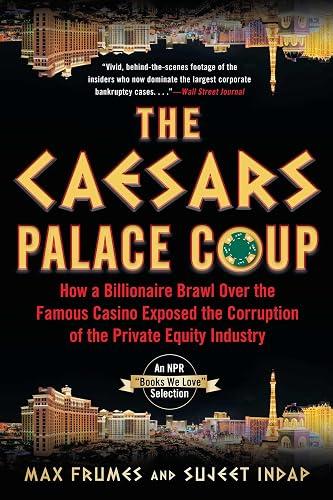
Get the complete 30-minute summary of The Caesars Palace Coup
Get the complete summary in the appThe Caesars buyout loaded the company with $24 billion in debt just as the global financial crisis began, making default
Apollo and TPG used their control of Caesars to transfer valuable assets out of the operating company and into new entit
The asset transfers were designed to build a "war chest" for Apollo at the expense of creditors, as revealed by internal
Apollo attempted to terminate the parent guarantee through a manufactured 5 percent stock sale, which creditors challeng
The examiner's report found evidence of fraudulent transfers and estimated potential damages at $3.6 billion to $5.1 bil
Judge Goldgar's rulings consistently favored the junior creditors and pressured Apollo to settle.
"The Caesars Palace Coup" is a strong fit if you want practical ideas around business, finance, law, especially themes like the caesars buyout loaded the company with $24 billion in debt just as the global financial crisis began, making default; apollo and tpg used their control of caesars to transfer valuable assets out of the operating company and into new entit. The MinuteRead summary distills these concepts into a focused read, whether you're deciding whether to buy the book or applying its lessons at work.
Motivated to help readers with "We have been trained to drive a Ferrari and now we are stuck in a Kia." A gamble gone wrong, Max Frumes wrote “The Caesars Palace Coup” to package those ideas for a fast, focused read. In “The Caesars Palace Coup”, Max Frumes focuses on "We have been trained to drive a Ferrari and now we are stuck in a Kia." A gamble gone wrong. Through “The Caesars Palace Coup”, Max Frumes distills the core ideas on business into lessons readers can absorb in a single short sitti…
Continue Reading
Access the complete 30-minute summary and thousands more nonfiction books in the MinuteRead app.

Continue reading the complete summary in the MinuteRead app.






