 MinuteRead
30 min
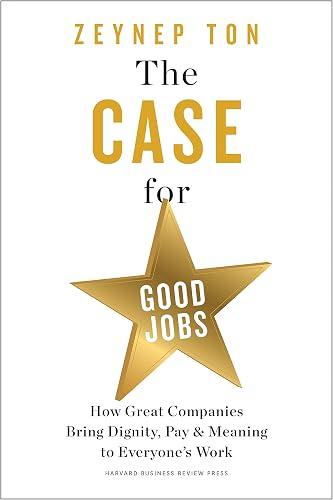
Book summary
by Zeynep Ton
Premium summary · Opens in the app · 30 min read
Walk into almost any big-box retail store, fast-food restaurant, or call center in America and you will see the same story playing out. Understaffed shifts. Exhausted employees who do not know their schedules from one week to the next. Managers who spend more time recruiting replacements than developing their teams. Customers waiting too long for help from workers who lack the training or the motivation to solve their problems.
**Author:** Zeynep Ton
**Estimated Reading Time:** 42 minutes
**What You'll Learn:**
- Why the conventional wisdom about low-wage work is wrong - How companies like Costco and QuikTrip turn higher pay into higher profits - The hidden costs of turnover that most leaders never calculate - The four operational choices that make good jobs possible - How to break free from the vicious cycle of mediocrity - A practical roadmap for transforming your organization
**Who This Book Is For:**
This book is for leaders who suspect that treating employees as costs to be minimized is a losing strategy. It is for managers frustrated by high turnover and inconsistent execution. It is for investors who want to understand why some companies consistently outperform their peers. And it is for anyone who believes that work should provide dignity, not just a paycheck.
Walk into almost any big-box retail store, fast-food restaurant, or call center in America and you will see the same story playing out. Understaffed shifts. Exhausted employees who do not know their schedules from one week to the next. Managers who spend more time recruiting replacements than developing their teams. Customers waiting too long for help from workers who lack the training or the motivation to solve their problems. The conventional explanation for this state of affairs is simple: it is unavoidable. Low-cost business models require low-cost labor. You cannot pay people more and still offer affordable products. Turnover is just part of the game. Employees in these jobs are interchangeable, and investing in them makes no financial sense. Zeynep Ton, a professor at MIT's Sloan School of Management, spent years studying this assumption. What she found should disturb every business leader who has accepted it. The assumption is not just wrong. It is dangerously, expensively wrong. Ton began her research with a simple question: why do some companies that compete on low prices treat their employees well while others do not? She looked at Costco, which pays its workers significantly more than Sam's Club and offers better benefits, yet consistently outperforms its rival. She studied QuikTrip, a convenience store chain that pays above-market wages and provides stable schedules, yet has expanded profitably while many competitors struggle. She examined Trader Joe's, Mercadona in Spain, and other companies that have built successful business models on the foundation of good jobs. The pattern she discovered was unmistakable. Companies that invest in their frontline employees do not succeed despite those investments. They succeed because of them. The problem is that most companies are trapped in what Ton calls a vicious cycle. They pay low wages, so they get high turnover. High turnover means they cannot train employees well or hold them to high…
Continue reading in the MinuteRead app
Get the complete 30-minute summary of The Case for Good Jobs
Get the complete summary in the appGood jobs are profitable. Companies that invest in frontline employees consistently outperform their competitors.
The vicious cycle of bad jobs is self-reinforcing. Low investment leads to high turnover, which leads to poor performanc
The costs of bad jobs are largely invisible. Companies underestimate what they lose through turnover, inexperience, and
Low pay creates a bandwidth tax. Financial stress impairs cognitive performance and reduces job effectiveness.
High turnover is far more expensive than most leaders realize. The true cost can be 20 to 45 percent of annual payroll.
The good jobs strategy combines investment in people with four operational choices: focus and simplify, standardize and
"The Case for Good Jobs" is a strong fit if you want practical ideas around business, management, economics, especially themes like good jobs are profitable. companies that invest in frontline employees consistently outperform their competitors; the vicious cycle of bad jobs is self-reinforcing. low investment leads to high turnover, which leads to poor performanc. The MinuteRead summary distills these concepts into a focused read, whether you're deciding whether to buy the book or applying its lessons at work.
Motivated to help readers with 1) Good jobs are not just ethical, Zeynep Ton wrote “The Case for Good Jobs” to package those ideas for a fast, focused read. In “The Case for Good Jobs”, Zeynep Ton focuses on 1) Good jobs are not just ethical. Through “The Case for Good Jobs”, Zeynep Ton distills the core ideas on business into lessons readers can absorb in a single short sitting. Readers turn to this work when they want Zeynep Ton's perspective on the subject without working through the entire o…
Continue Reading
Access the complete 30-minute summary and thousands more nonfiction books in the MinuteRead app.

Continue reading the complete summary in the MinuteRead app.






