MinuteRead
30 min
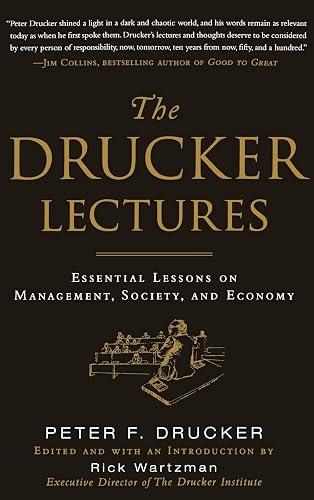
Book summary
Premium summary · Opens in the app · 30 min read
Peter Drucker spent more than six decades thinking about one deceptively simple question: How do human beings organize themselves to accomplish things that no individual could accomplish alone?
**Author:** Peter F. Drucker **Estimated Reading Time:** 48 minutes
**What You'll Learn:** - Why management is a liberal art, not merely a technical discipline - How the rise of knowledge workers fundamentally changed organizational power - What makes executives truly effective - Why nonprofits became the most dynamic sector in American society - How to manage yourself in a world where careers outlast organizations
**Who This Book Is For:** This book is for anyone who leads, manages, or hopes to lead. It is for executives who sense that spreadsheets alone cannot capture the truth of their organizations. It is for knowledge workers who want to understand their own value and take charge of their careers. It is for nonprofit leaders who need practical wisdom without sacrificing mission. And it is for students of organizations who want to see the big picture that connects history, economics, psychology, and ethics into a coherent way of thinking about work and society.
Peter Drucker spent more than six decades thinking about one deceptively simple question: How do human beings organize themselves to accomplish things that no individual could accomplish alone? That question took him from the factories of mid-century America to the boardrooms of global corporations, from the offices of government agencies to the volunteer halls of churches and community organizations. Along the way, he became the most influential management thinker of the twentieth century. He coined the term "knowledge worker." He predicted the rise of the information economy decades before the personal computer existed. He taught executives at General Electric, Procter & Gamble, and Toyota, yet he spent his final years working primarily with nonprofit leaders, whom he considered the true pioneers of modern management. But Drucker was never interested in management as a set of techniques. He saw management as something far more important: a social function, a moral practice, and a liberal art. This is the central insight that runs through his lectures, essays, and books. Management is not simply about efficiency, productivity, or profit. It is about enabling human beings to perform together, to create value for customers, to build institutions that serve society, and to find meaning in their work. When management is done well, it strengthens communities, develops people, and advances civilization. When it is done poorly, it degrades trust, wastes talent, and undermines the very foundations of free society. The modern world, Drucker argued, is a society of organizations. Almost every important task, from healthcare to education to scientific research to the production of goods, happens inside organizations. And organizations do not run themselves. They require management. This means that the quality of our lives depends, to a remarkable degree, on the quality of management. Yet most…
Continue reading in the MinuteRead app
Get the complete 30-minute summary of The Drucker Lectures
Get the complete summary in the appManagement is a liberal art, not just a technical discipline. It requires understanding of history, sociology, psycholog
Knowledge workers own the means of production. Their expertise is their capital, and organizations must treat them as pa
Innovation is a discipline. It can be learned and practiced systematically, not left to chance or genius.
The unexpected is a powerful source of innovation. Pay attention to unexpected successes and failures.
Effectiveness is about results, not effort. The question is "What am I contributing?" not "How hard am I working?"
Focus on strengths, not weaknesses. Build on what you are good at and make your weaknesses irrelevant.
"The Drucker Lectures" is a strong fit if you want practical ideas around business, management, leadership, especially themes like management is a liberal art, not just a technical discipline. it requires understanding of history, sociology, psycholog; knowledge workers own the means of production. their expertise is their capital, and organizations must treat them as pa. The MinuteRead summary distills these concepts into a focused read, whether you're deciding whether to buy the book or applying its lessons at work.
Motivated to help readers with management is a liberal art, Peter F. Drucker wrote “The Drucker Lectures” to package those ideas for a fast, focused read. In “The Drucker Lectures”, Peter F. Drucker focuses on management is a liberal art. Through “The Drucker Lectures”, Peter F. Drucker distills the core ideas on business into lessons readers can absorb in a single short sitting. Readers turn to this work when they want Peter F. Drucker's perspective on the subject without working through the en…
View all summaries by Peter F. DruckerContinue Reading
Access the complete 30-minute summary and thousands more nonfiction books in the MinuteRead app.

Continue reading the complete summary in the MinuteRead app.