 MinuteRead
30 min
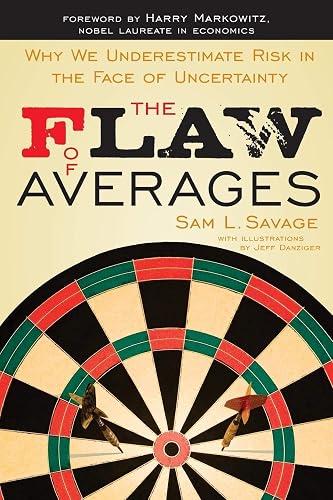
Book summary
by Sam L. Savage
Premium summary · Opens in the app · 30 min read
Every year, organizations around the world make decisions worth trillions of dollars based on a simple but dangerous assumption: that the future will resemble the average of the past. They build budgets around average sales figures. They design supply chains around average demand. They construct investment portfolios around average returns. And then, with remarkable regularity, reality refuses to cooperate.
**Author:** Sam L. Savage
**Estimated Reading Time:** 45 minutes
**What You'll Learn:** Why plans based on average assumptions fail, how to think in terms of probability distributions instead of single numbers, and practical methods for managing uncertainty in business and life.
**Who This Book Is For:** Decision-makers, managers, investors, analysts, and anyone who has ever watched a carefully planned project go wildly off course and wondered why.
Every year, organizations around the world make decisions worth trillions of dollars based on a simple but dangerous assumption: that the future will resemble the average of the past. They build budgets around average sales figures. They design supply chains around average demand. They construct investment portfolios around average returns. And then, with remarkable regularity, reality refuses to cooperate. The project runs six months late. The market crashes. The new product sits unsold in warehouses. The retirement fund loses half its value. When these failures occur, we tend to blame bad luck, unforeseen circumstances, or the inherent unpredictability of the world. But Sam L. Savage argues that the real culprit is often much simpler and far more avoidable: we are using the wrong mathematical tools to think about uncertainty. The problem begins with a number that seems innocent enough. The average. Also known as the mean, the expected value, the most likely scenario. It appears in spreadsheets, boardroom presentations, government reports, and news headlines. It feels precise, scientific, and reassuring. But Savage demonstrates that this familiar number conceals a trap that has swallowed countless plans, projects, and portfolios. The trap works like this. When you replace an uncertain quantity with its average, you are not simplifying reality. You are distorting it. You are pretending that a range of possible outcomes is a single point. You are assuming that the distribution of possibilities is symmetrical, well-behaved, and predictable. And in doing so, you systematically underestimate the likelihood and severity of extreme events. Savage calls this the Flaw of Averages, and he argues that it is one of the most pervasive and costly errors in modern decision-making. The flaw states that plans based on average assumptions are wrong on average. Not occasionally wrong. Not wrong under unusual circumstances. Wrong on average, as a matter of mathematical necessity, whenever the relationships between variables are nonlinear or the distributions are skewed. Consider the statistician who drowns while wading across a river with an average depth of three feet. The average tells him nothing about the deep hole in the middle. Or consider the investor who plans for an average annual return of eight percent, only to discover that the sequence of returns matters as much as the average. A portfolio that gains fifty percent one year and…
Continue reading in the MinuteRead app
Get the complete 30-minute summary of The Flaw of Averages
Get the complete summary in the appPlans based on average assumptions are wrong on average.
An uncertain number is a shape, not a point.
Always ask for the distribution, not just the average.
Diversification reduces risk without reducing expected return, but only if the risks are uncorrelated.
Uncertainty creates value when you have flexibility.
The value of an option depends on the full distribution of outcomes, not the average.
"The Flaw of Averages" is a strong fit if you want practical ideas around business, science, mathematics, especially themes like plans based on average assumptions are wrong on average; an uncertain number is a shape, not a point. The MinuteRead summary distills these concepts into a focused read, whether you're deciding whether to buy the book or applying its lessons at work.
Motivated to help readers with plans based on average assumptions are wrong on average, Sam L. Savage wrote “The Flaw of Averages” to package those ideas for a fast, focused read. In “The Flaw of Averages”, Sam L. Savage focuses on plans based on average assumptions are wrong on average. Through “The Flaw of Averages”, Sam L. Savage distills the core ideas on business into lessons readers can absorb in a single short sitting. Readers turn to this work when they want Sam L. Savage's perspective o…
Continue Reading
Access the complete 30-minute summary and thousands more nonfiction books in the MinuteRead app.

Continue reading the complete summary in the MinuteRead app.






